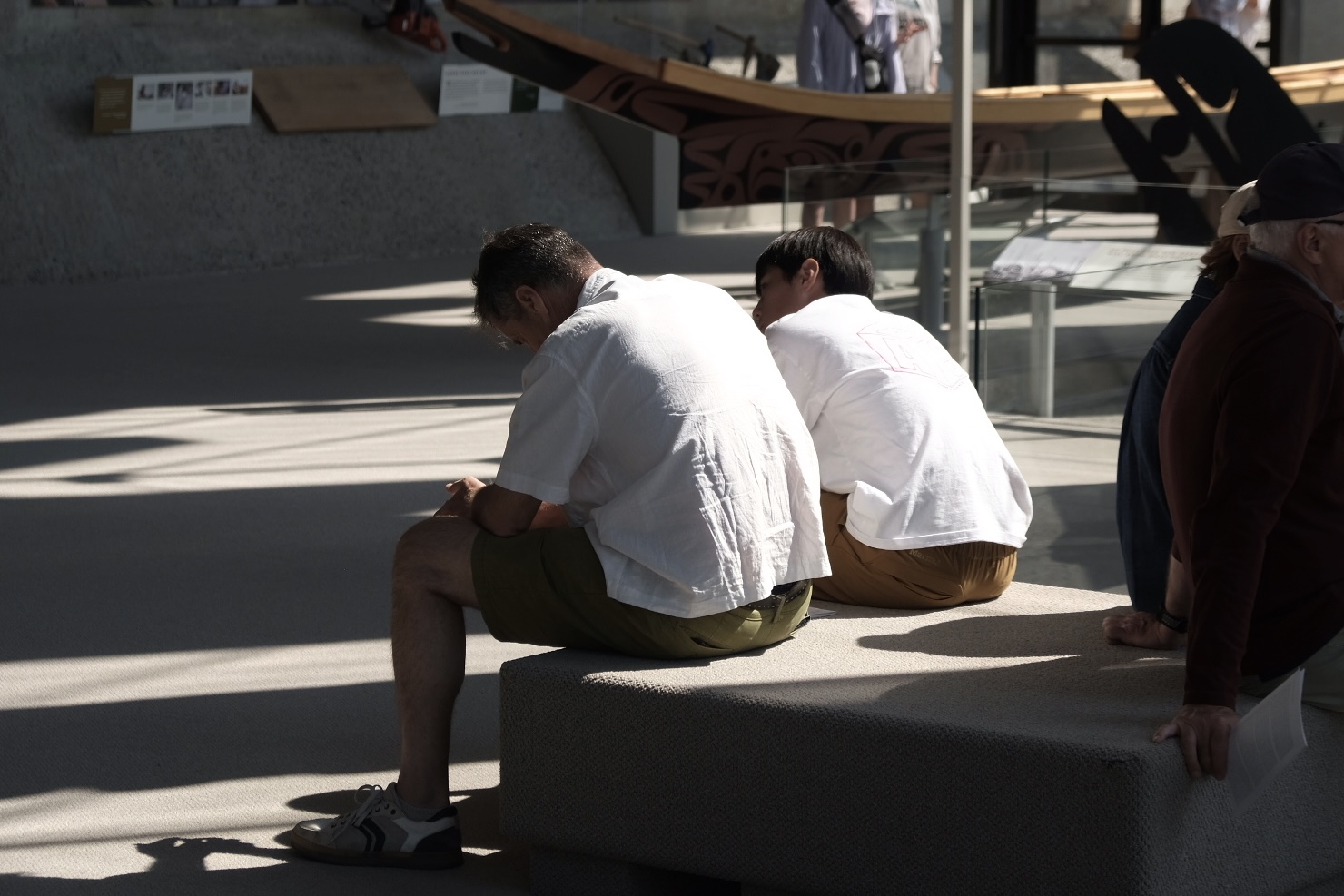
Photo by Brian Nguyen
The first words I ever spoke were in Toisan, Cantonese; Ge Ge. Brother. I was calling for my big brother Jin. Two years later, my baby sister was born. Mei Mei, we called her, little sister. We were born to an Irish Catholic mother and a Southern Chinese father. Mum and Baba. Two halves of a whole that did not match. I learned English and Toisan side by side, as one language. Eventually, English overtook my father’s tongue, and now I only remember words and phrases that were used constantly in our household. I know the names of my favourite fruits, curse words and slurs, animals and what sounds they make. But I never learned the words for I’m sorry.
Baba was never good at talking about his feelings. He never learned how. His father, my Yeh Yeh, immigrated to Canada from Guangdong on a steamboat all alone at fifteen years old and never talked much about anything, especially not his feelings. And yet, I loved them both. Ngo ai ni, Baba I love you dad. I can’t seem to recall if I ever heard those words back.
Apologies from Baba growing up were silent. A bowl of sliced fruit was delivered to my hands, and he would sit on the edge of my bed while I ate the first bite, watching me with an unreadable expression on his face. I assumed the expression was remorse, maybe shame. I would take a bite and taste sweetness with a surprising bite; yong chong — onion. Baba hadn’t washed the cutting board after preparing dinner. The flavours clash, and the scent of the ripe fruit is tainted with a sharpness that brings tears to my eyes. Maybe it’s from the yong chong, or maybe it’s the weight of the space between us. Goh je, I would say, Thank you. My forgiveness was silent as well. It wasn’t a choice; it was a given, the necessary payment for a bowl of cut and skinned fruit. I remember the names of these foods like I remember my siblings’ names: ping guo apple, chang orange, pi dou grapes, li zhi lychee. I thought eventually one day he would spit out an ‘I’m sorry’. He sometimes looked at me like he wanted to, but he never did. Maybe Baba never learned the words either.
When I was fifteen, I had to get my wisdom teeth removed. Baba drove me to the dentist and waited in the car for me to be finished. When I woke up from anesthesia, swollen, confused, and high as a kite, I only remember crying to the nurse, ‘Baba.’ I begged, ‘Baba, please.’ They brought him in, and he carried me to the car, took me home, and tucked me into bed, all without uttering a single word to me. I had come to believe that his silence was strength. He told me later that he enjoyed that day, that in that moment, he felt like I was a baby again.
Halfway through my senior year of high school, Baba left my family for a young blonde woman from the gym who was born the same year he married my Mum. He had decided he wanted something
new, someone new. A new baby. So he left quietly, as if he was slipping out my door after tucking me into bed.
His silence no longer feels like strength, but cowardice. All those times he sat on my bed watching me eat ping guo, the look in his eyes wasn’t remorse, but fear. Fear of two small words he couldn’t bring himself to say. A Chinese man is raised to believe he must always seem strong, and the words ‘I’m sorry’ contradict the image they all yearn to have. To apologize is to admit you made a mistake, and making mistakes is unacceptable. They would rather choke to death on the words than breathe them into the air. Words are like our cold jade bangles, passed down generation to generation. You can’t give what you don’t have.
Perhaps one day Baba will come home. Maybe he’ll feel sorry, maybe he’ll even finally know how to say it this time. Maybe he’ll show up with a bowl of fruit. But I wonder, if that day ever comes, will I even understand the words he says?
Ma Wai-Yun is a Queer, mixed-race Chinese and Celtic artist from Greater Vancouver, BC. They are a student at Emily Carr University and expand on themes of diaspora, self-reflection, and cultural identity through various media, including painting, writing, and illustration.
Brian Nguyen is a visual storyteller whose creative path has taken him from Hanoi to Busan to Vancouver. Recently joining Ricepaper Magazine as Visual Editor, Brian brings a fresh and dynamic perspective shaped by his cross-cultural journey. With a background in Professional Communication and a passion for photography, he believes his mission is to connect with people—visually and emotionally—through stories that uplift, encourage and humanize. For Brian, visual storytelling isn’t just about aesthetics, it’s about reaching people where they are and making them feel seen.
1 comment
This piece was incredibly moving. The line “you can’t give what you don’t have” really stayed with me.