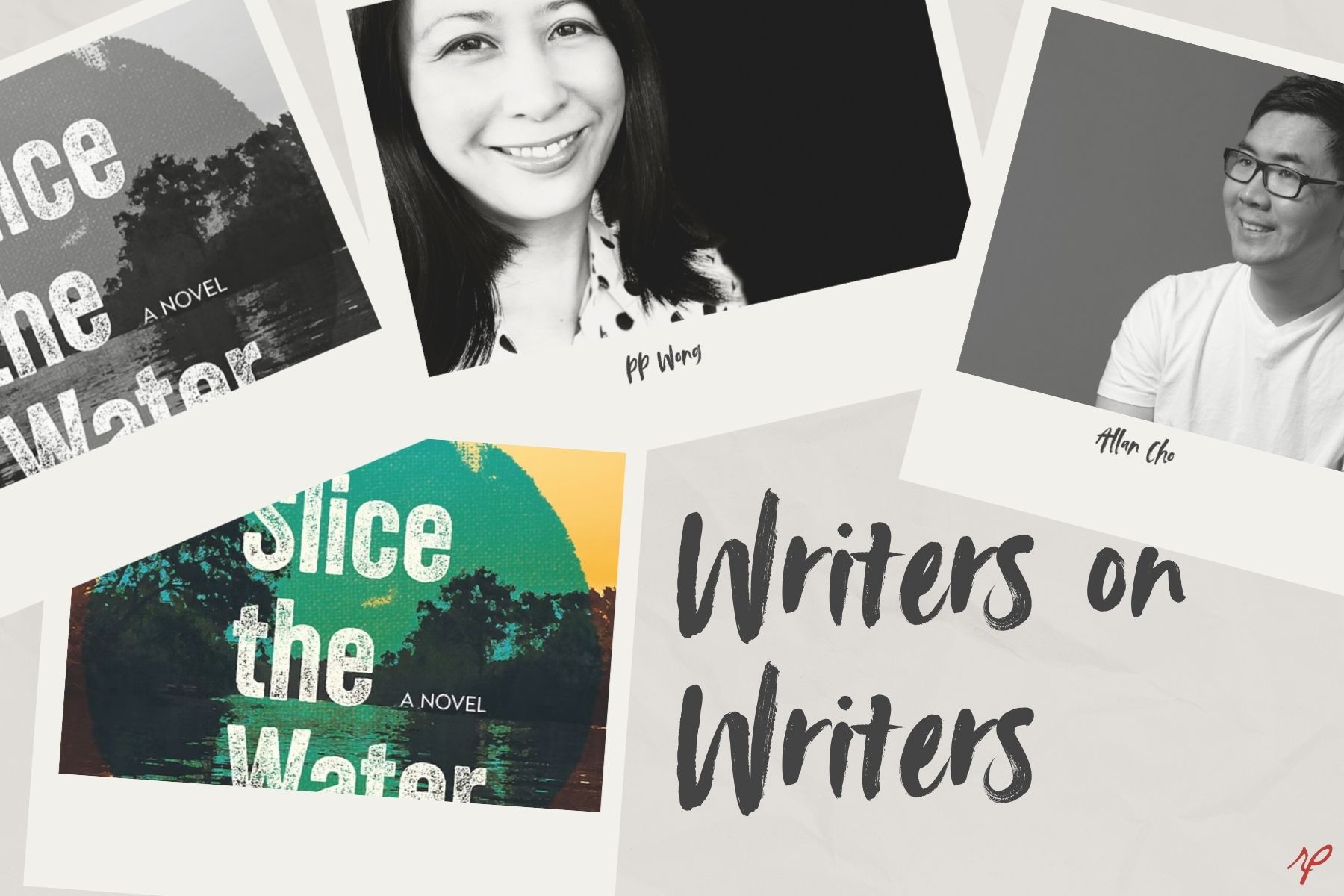
Writers on Writers with PP Wong and Allan Cho
Ricepaper’s Executive Editor and multi-genre writer, Allan Cho, interviews PP Wong, author of the new novel, Slice the Water. A dystopian thriller, a speculative fiction, and a coming-of-age story, Slice the Water thrums with biting bursts of staccato-like prose — a fitting accompaniment to a fascinating exploration of contrasting political systems.
Born on the lush island nation of Mahana, Fred lives under the tyrannical rule of a book-pulping king. When Fred’s father suddenly disappears, he joins an underground movement of dissenters and becomes an unwitting global icon in the fight for Mahanian freedom. Recruited and relocated by an organization that appears sympathetic to his cause, Fred arrives in a seemingly peaceful foreign nation, where the impact of social media and technology creates a new, stranger struggle.
Allan Cho: Slice the Water is a powerful, poetic title. What does it mean to you, and how did it shape the story?
PP Wong: Thank you, I’m thrilled to hear you like the title! Slice the Water is a line from a pivotal scene in the book. Without giving too much away, it is also a turning point in the book, where the protagonist, Fred, has to decide on an action that will mark a point of no return. It’s meant to evoke the idea of action within an impossible task. Also, I love the free-flowing nature of water, and since this novel is about freedom, it seems pretty apt that water would be part of the title.
What was your writing process like for this novel? Did it differ from your earlier work, The Life of a Banana?
My writing process was similar to The Life of a Banana in that I’m a planner. I have a terribly messy desk, but when it comes to the structure of the story, I’m quite meticulous in ensuring I have the complete story before I begin writing a word. But reaching that completeness starts with note-taking, scribbles of scenes and snatches of conversations, likes and dislikes of characters, foods they enjoy, and jokes they tell. Then I write paragraphs for each chapter, so I am clear about the beginning, middle, and end. The narrative will inevitably evolve as I complete the novel, but having a clear vision helps me write.
Your novel opens with a powerful scene of soldiers destroying books—a moment that is very relevant in our world in 2025. What inspired you to begin the story with this act of censorship, and how do you see it reflecting today’s political climate?
When I was in a particular Asian country, I was told that in our country, you can write about anything, but you cannot write about topics X and Y. If you stick to these parameters, you will be fine. This deeply troubled me and left me questioning how far I should go as a writer and whether I could even write authentically if I had to put limitations on what I wrote. I know people who have been jailed for their writing or for their passion to speak up. So, I am fully aware of the consequences of words and bold actions. I do think freedom of speech is important because without it, people do not know the truth. At the same time, this concept of freedom and the idea of what freedom of speech truly means are not black-and-white entities.
For example, in the West, we live in a society where freedom of speech is taken to an extreme level, with dangerous social media posts that create lies. Taken even further recently with AI and people now making videos of clones of well-known people, putting words into their mouths that they would never say. Of course, I do think censorship is wrong, but there needs to be more laws to help prevent the harm that the freedom in technology, especially social media, is bringing to our society and to our young people.
Slice the Water, alongside works like The Handmaid’s Tale and The Man in the High Castle, is a genre that has faced some saturation in recent years. How did you approach the challenge of writing within such a crowded literary landscape?
I always find it interesting when the publishing world places novels into a specific ‘category.’ I completely understand why it needs to be done for marketing reasons, etc. However, when I wrote Slice the Water, I was actually not intending to write a novel in a particular genre, such as dystopian or speculative fiction. I just picked up my pen and went where the story took me —sometimes to exciting, amusing, and unexpected places.
When I write, I don’t really think of other novels or what is out there. Instead, I just focus on the characters and the story I want to tell on the page. At the heart of it, the novel is about discovering what it means to be free, and about family and community. It just happens to have some magical realism!
In terms of having a fresh POV, I do think representation is important, and I know there isn’t an abundance of novels published in the West from a Southeast Asian perspective, especially with speculative elements.
I grew up in the UK and have also lived in post-colonial Asian countries. I was always interested in the concept of freedom, what it means to be free. Also, I wanted to explore whether we are truly as ”free” as we think in the West and also how post-colonial societies still grapple with the skeletons of a colonized past. I hope this novel contributes positively to the literary canon, offering a fresh British-Canadian-Southeast Asian perspective in this genre!
What was your vision for the world of Mahana, and how did you balance political allegory with storytelling?
That’s a good question! My vision for Mahana was to create a world that feels both unique and familiar. A place where readers could escape into something imaginative while still recognizing echoes of their own society. I suppose once you start building a world, questions of power, inequality and justice naturally emerge. Every society, real or fictional, reveals its politics and power imbalances through how people live, love and survive.
I believe the best political allegories are deeply rooted in empathy rather than ideology.
The key for me was balance. The allegory had to serve the story, not overshadow it. So, I very much focused on telling the best story I could.
How did you conceptualize Fred as a protagonist, and what qualities did you want readers to see in him?
When I first began shaping Fred as a protagonist, I actually started with his voice: the way he speaks, how he observes the world, and how he internalizes what happens around him. For me, I do something I like to call ”method writing.” I step into a character’s skin and see life entirely through their eyes. With Fred, I wanted to capture that sense of a young man who isn’t yet fully formed, someone still being shaped by the harshness and unpredictability of life.
Grief and loss play a significant role in moulding him, just as they do for all of us. I wanted readers to see that process, how difficult experiences can carve out both strength and vulnerability in a person. Fred isn’t smooth-edged or easily defined; he’s complex, sometimes contradictory, and that’s what makes him real to me.
One of my favourite moments in the novel is Fred’s conversation with Jim, when they wrestle with the idea of sacrifice. What it means to give something up for the greater good, and where the moral boundaries of that lie. In that scene, Fred reveals a side of himself that might surprise readers, a glimpse into the tension between who he is and who he wants to be.
Ultimately, I wanted Fred to feel human. Imperfect, unpredictable, and profoundly shaped by what he’s lived through. Characters, like people, are never just one thing. They carry their grief, their choices, their contradictions, and that’s what makes them complex and fascinating.
Moments like the confiscation of Fred’s pet frog and the forced reproduction law stood out as chilling and politically sharp. What role does political commentary play in your writing, and how do you navigate making those moments both meaningful and uncomfortable?
In writing, I always start with character. If readers care deeply about the people at the heart of the narrative and feel their sorrow and joy, the themes will resonate more deeply.
I believe that in novels, the best commentaries are the ones we feel before we fully understand.
Political commentary, for me, isn’t something I set out to impose on the story, or on the reader. Instead, it tends to emerge from the emotional and moral dilemmas the characters inhabit. When I created the moments with Fred’s pet frog and the chilling forced reproductive laws, I was really thinking about power, loss, and the fragile boundaries of human dignity. For sure, those are political ideas, but they’re also deeply personal.
I wanted to explore what it feels like to live in a system that can take away something precious or dictate something as intimate as one’s body and choices for their body. When someone feels the discomfort, it becomes part of you and perhaps even a mirror showing us what we might accept or resist in our own world.
What writers or works have most influenced your craft and your worldview?
As a child, I loved reading LM Montgomery and CS Lewis’ Narnia series. Perhaps my love for LM Montgomery is why I ended up making Canada home. I watched the Megan Follows TV series on repeat!
Later, as a teenager, I don’t recall reading any YA books, mostly literary fiction that I borrowed from the library or political books that my Dad had, like George Orwell. I remember saving up to buy the hardback of The Blind Assassin. Later, when it won the Booker, I thought how amazing it was that it had won, because the novel had a bit of everything — mystery, love, Sci-Fi, and characters I loved.
Seeing how Margaret Atwood could write with such bravery gave me the confidence to write the stories I wanted to tell. Perhaps it also provided me with the strength to create Slice the Water, a novel that, in some ways, defies being put into a neat little box. The narrative has speculative elements and exploration of AI and technology, but ultimately remains a story about family, love, and community.
What do you hope readers will carry with them after finishing Slice the Water?
I’m grateful for everyone who reads the book, and my wish is for readers to simply enjoy the read! Maybe to have a chuckle and even shed a few tears. To leave the story with a feeling of hope. Which we need in our perplexing and challenging world.
PP Wong is a novelist, screenwriter and editor. Her debut novel, The Life of a Banana, was nominated for the Women’s Prize for Fiction and featured in numerous outlets, including The Guardian, The Independent, Corriere Della Sera, The Straits Times, Bangkok Post, Vanity Fair (Italy), BBC Radio 4 Women’s Hour, Radio Television Hong Kong and BBC World. PP completed an MFA at the University of British Columbia, specializing in TV writing, and received the celebrated Cordula and Gunter Paetzold Fellowship. She has a degree in Anthropology and Law from The London School of Economics. PP is working on her novel and TV adaptation, IBT, with the legendary Victoria Sanders. She has roots in Canada, England and Singapore.
Allan Cho is a writer, editor, librarian, and community organizer whose work explores identity, intergenerational trauma, and chronic illness. His creative nonfiction and essays have appeared in literary journals and anthologies across Canada. Based in Vancouver, Allan also serves as Executive Editor of Ricepaper Magazine and Executive Director of the Asian Canadian Writers’ Workshop, where he supports emerging voices in Asian Canadian literature. He is a graduate of Simon Fraser University’s The Writers Studio.