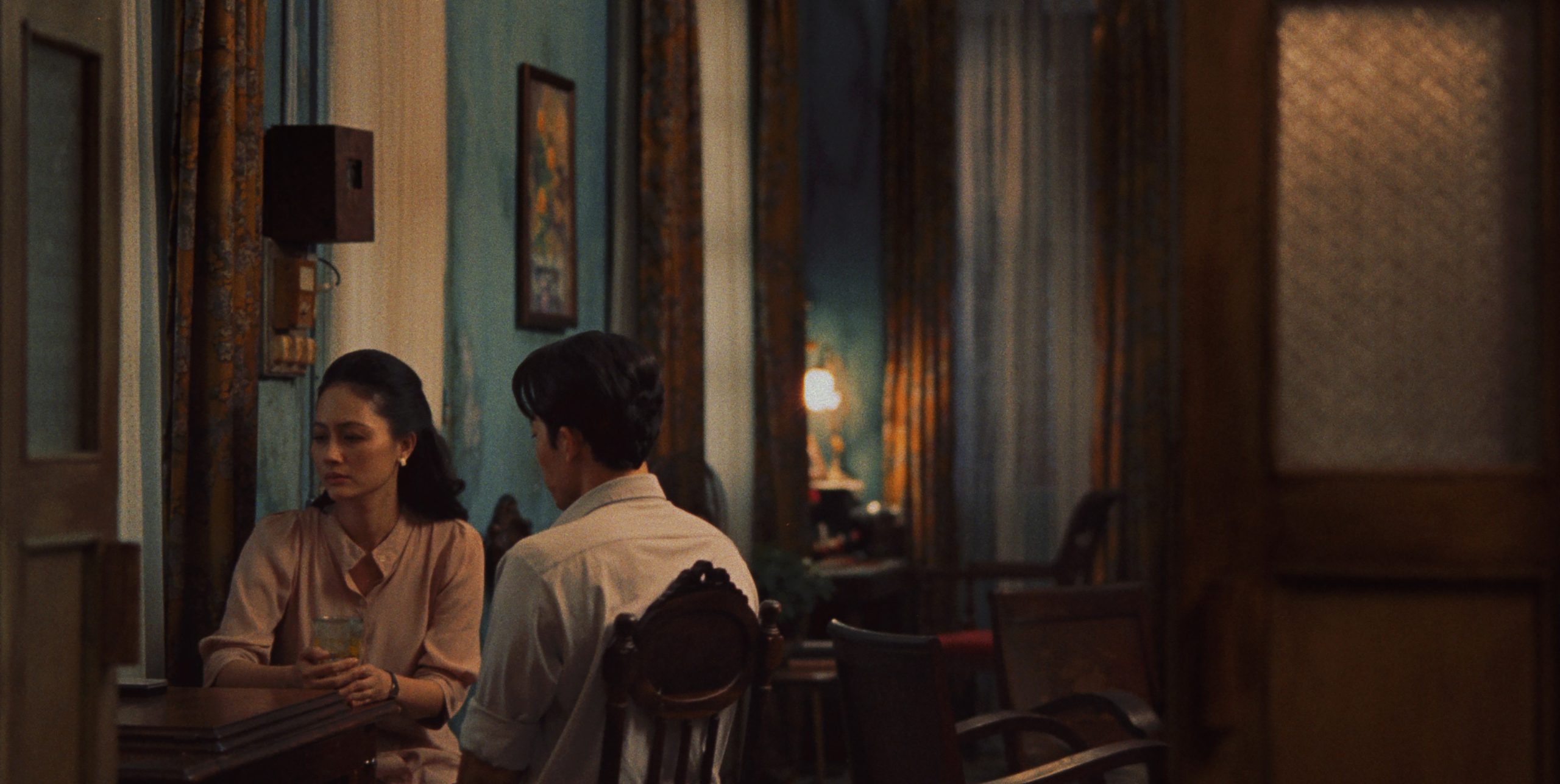
Seven years after his debut feature Song Lang (2018), a romantic drama steeped in modern Vietnamese folk opera, Leon Lê reunites with key members of his cast and crew for another sentimental period piece taking place in 1980s Saigon. Drawing inspiration from a crusty neighbour who once lived below his dwelling when he was making Song Lang, Lê completely reimagines this figure at her core and builds a love story around her. The film also serves as a nostalgic portrait of the Saigon of his youth, a city rapidly erased by development. For this reason, both Song Lang and Ky Nam Inn were shot in Chợ Lớn, the district in Saigon that still retains the textures and rhythms of the era. Photographed luxuriantly in 35mm by cinematographer Bob Nguyễn, the film adopts a soft palette scheme evocative of retro Southeast Asian urban interiors, with each frame composed for picture perfection on the silver screen. Although a rich political history anchors his story, Lê consciously avoids title cards and expositions to explain certain aspects of this—mostly to skirt domestic censorship—and relies instead on oblique hints and visual clues. While the love story can stand on its own terms, only those versed in the politics of the period will come away better satiated. Foreign audiences, however, face an extra hurdle, since much of the story’s meaning will be lost through translation. All these are formidable obstacles in a contemporary filmgoing culture that increasingly privileges instruction over inference: where ‘Tell, don’t show’ is the order of the day.
Bookended by the present and recounted through a single flashback, a bachelor reminisces wistfully on his brief encounter with a woman he could ill afford to pursue, constrained by his career aspirations and the conservative mores of the time. Set in Saigon in 1985, a decade after the end of the American war when North Vietnam liberated the South from the imperialists, the film unfolds in a newly unified country still trapped in poverty. Through his uncle’s patronage, Khang (Liên Bỉnh Phát), a privileged young translator from Da Lat secures a job in a publishing house and is tasked to translate Antoine de Saint-Exupéry’s 1943 French novella The Little Prince into Vietnamese. While sequestered in a teeming walk-up apartment, he comes across Kỳ Nam (an outstanding Đỗ Thị Hải Yến), an elegant older woman whose reserve, chastity and intellectual poise reflect his own, and who runs a catering business from the apartment below his. Named after agarwood, a fragrant wood prized in perfumes and medicines, Kỳ Nam is a widowed single mother of two sons who now lives alone. A quiet attraction takes root between the pair, but advances no further than stolen glances and polite conversation. Despite national unification, divisions from the successive blows of French colonialism and US-sponsored civil war persist. Originally a Northerner with ties to the former Republic’s military, Kỳ Nam is viewed with distrust within the community. While any unease is muted, occasional provocations force her to maintain a low profile.
It is also through the ensemble of supporting characters that the political undercurrents of the time can be inferred, such as in the wiry Uncle Hao (Lê Văn Thân), a doctor with a fondness for banned music whose family we later learn had once owned the tenement. However, the most consequential supporting figure of the lot is Su (Trần Thế Mạnh), an orphaned teenager who helps Kỳ Nam in the kitchen and runs her deliveries, and who is captivated when Khang introduces The Little Prince to him. Frequently bullied because of his ethnicity and later offered the chance to immigrate to the US, Su’s experiences leave little doubt as to how biracial children were viewed after the war. Conversely, the least controversial strand in the story concerns Khang’s translation of Saint-Exupéry’s The Little Prince, a work which remains immensely popular in Vietnam today in part because of its Saigon connection. Saint-Exupéry, a commercial and military aviator, is said to have drawn inspiration for the novella from his failed attempt to break a speed record for a Paris to Saigon flight in 1945, an ordeal echoed in the pilot narrator’s crash landing in the Sahara. In the film, the translation assignment carries prestige as it is hoped this new version will surpass the landmark 1966 original by the late poet and writer Bùi Giáng. Khang, who deeply reveres Bùi, ultimately encounters his eccentric idol by chance late in the film, in the only scene where a real historical figure is faithfully portrayed within an otherwise fictional world.
TIFF’s relationship with Vietnamese cinema has been threadbare: just six feature films have been programmed in the past dozen years, effectively making this economically ascendant nation a biennial curiosity. While this tally is trifling, it mirrors representation from other Southeast Asian cinemas and confirms Vietnam’s marginal standing within the festival’s priorities, especially when contrasted with the sustained attention accorded to Japan and Korea. Since its domestic theatrical release last November, Ky Nam Inn has earned about VND 5 billion (C$265,000) against a VND 26 billion (C$1.3 million) budget. This was reportedly due to limited screenings and odd time slots, shortsighted promotion, and the vagaries of the exhibition system. Despite tepid box office returns, the film has nevertheless been widely embraced for its artistry. For comparison, a historical war film released last August and directed by a sitting Lieutenant Colonel in the People’s Army of Vietnam took a little over two weeks to become the highest-grossing Vietnamese film of all time, closing its run just over a month later at VND 714 billion (C$37.6 million). Following Ky Nam Inn’s world premiere at TIFF, the film returned for one screening at Toronto’s Regent Park Film Festival in November. This encore included at least one additional scene absent from the TIFF cut, depicting guests at a wedding anniversary party being brought to a police station for questioning because public gatherings without a permit were banned at the time.
Brandon Wee