The Japanese too have the idiom of killing two birds with one stone, and Japanese filmmaker Hikari achieves this knockout feat nicely with her crowd-pleasing second feature. After a world premiere at TIFF last September and a North American theatrical release in November, her thoughtful and well-crafted dramedy has found modest box office appeal from its quirky Japanese subject while also firmly establishing her name as a talent to watch for in Hollywood. As its title suggests, the film centres on the business of rental family agencies, which provide clients with fake human relatives or relations by way of actors so that various appearances can be kept up in their lives. Originating in the 1990s in Japan as an extremely niche service but predictably sensationalized over time in the West as cultural kitsch, rent-a-family agencies have recently gained more mainstream visibility through magazine pieces, trend stories and late-night comedy bits. In cinema, this Japanese phenomenon has been explored in various documentaries and was most recently at the heart of several invisible titles: Werner Herzog’s Family Romance, LLC (2019), Sakamoto Takehito’s Rental x Family (2023), and even a ‘competing’ 2025 entry, Kosaka Ryunosuke’s Rental Kazoku. Despite Hikari’s harmless portrayal, rental family agencies are generally regarded in Japan as sketchy enterprises that have been known to engage in legally and morally dubious activities—several of which are sketched in her film for comedic and dramatic effect.
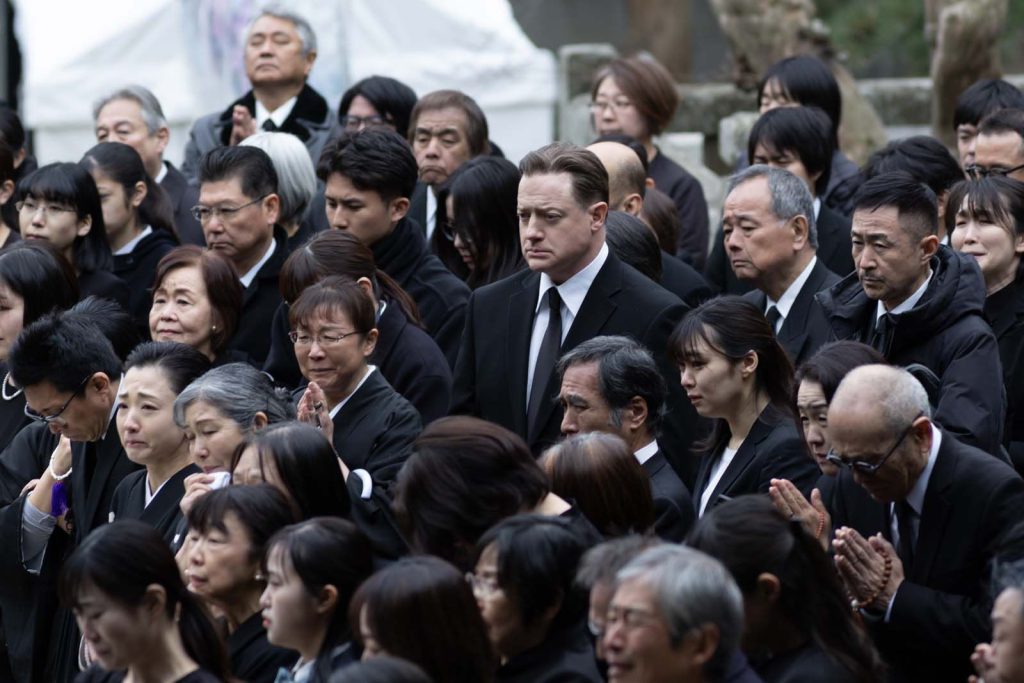
Introverted middle-aged American migrant Phillip Vanderploeg (Brendan Fraser) toils away at cheesy acting gigs in Tokyo while hoping for his agent to score him a breakout television role, until he is offered a more stable job in a rental family agency run by debonair boss Shinji (Hira Takehiro). His new role? An in-demand “token white guy” for every occasion. Initially thrown off by the cultural shock of it all, he soon warms to each eccentric part that comes his way. Soon, Phillip is presented with two major long-term assignments: one from a single Japanese mother (Shinozaki Shino) who needs him to appear for the first time to ‘their’ young daughter Mia (Shannon Mahina Gorman) so they can enrol her into a prestigious school; and the other from the daughter of a famous retired actor Hasegawa Kikuo (an excellent Emoto Akira), who needs Phillip to play a magazine journalist interested in writing about her father’s career and legacy before dementia consumes him. But without any training for the part, Phillip quickly makes the mistake of getting too emotionally attached to both of his clients, and it is this slip that elevates the core of the story from comically offbeat to emotionally resonant. A small parallel storyline involving Phillip’s colleague Aiko (Yamamoto Mari) also echoes this job’s conflicting nature: initially protective of the work they do, the strain of cycling through a variety of ghastly masks without any semblance of emotional investment on her part finally takes a toll on her well-being.
Osaka-born Miyazaki Mitsuyo, who goes by the mononym Hikari (meaning ‘radiance’, from the native Japanese reading of the first half of her given name), studied in the US as a teenager and later attained performing arts and filmmaking degrees. Her 2019 feature directorial debut was the astonishing 37 Seconds (TIFF 2019), about an aspiring manga artist with cerebral palsy who breaks free from the shackles of her protective mother to learn about sexuality from a kindly prostitute (the tart-with-a-heart trope is interestingly revived in Rental Family). From here, she directed episodes of the critically acclaimed American television serials Tokyo Vice (2022) and Beef (2023) before landing this project. 37 Seconds’ American co-cinematographer Stephen Blahut graduated to co-write (and executive produce) Rental Family alongside Hikari, inspired by his experience of coming across a rental family ad while job hunting in Japan. Beyond the film’s surface-level commentary on loneliness and alienation in contemporary Japan, Hikari does us the favour of stating in plain terms in a handful of scenes just how different Japanese culture is from those in Western spheres. Under the lens of a non-Japanese director of Japanese content, such nuances are usually lost. But because this film’s primary target is a specifically Western audience, Hikari self-consciously underlines these differences. Indeed, by the film’s end, we see a spirited defense of the rental family agency industry—and by extension, Japanese society’s need for it.
There is a third albatross that Hikari’s film could strike should it awaken the consciousness of Japanese audiences when it opens theatrically in Japan next month. At a time when Japan is facing a constant deluge of inbound foreigners due to decades of declining demographics and popular appeal alike, Hikari’s film should serve as introspection about how this stark reality is changing the island’s relationship with foreigners—especially in the unofficial racial hierarchy that exists within this group. Based on recent political developments in Japan, it appears a considerable portion of the electorate is fantasizing about a restoration of the country’s ‘locked country’ policy, which lasted over 200 years between the mid-17th to 19th centuries and which was marked by, among other things, a ‘no foreigners’ rule with only two exceptions. Phillip Vanderploeg is a white American male who has lived in Japan for seven years, is clearly a Japanophile, speaks passable Japanese but is not fluent, and gets by on meagre acting gigs only because advertisers and rental family clients prefer betting on a Caucasian commodity—even during an economic depression, as the film tells us. Foreigners from other demographics who comprise the more critical spine of Japan’s labour force might look on with envy or antipathy at this portrayal and wonder why such primacy seems to be exclusive and enduring. Soberingly, they might be told that just like during Japan’s isolationist period centuries ago, today only Dutchmen are the model foreigners.
Brandon Wee