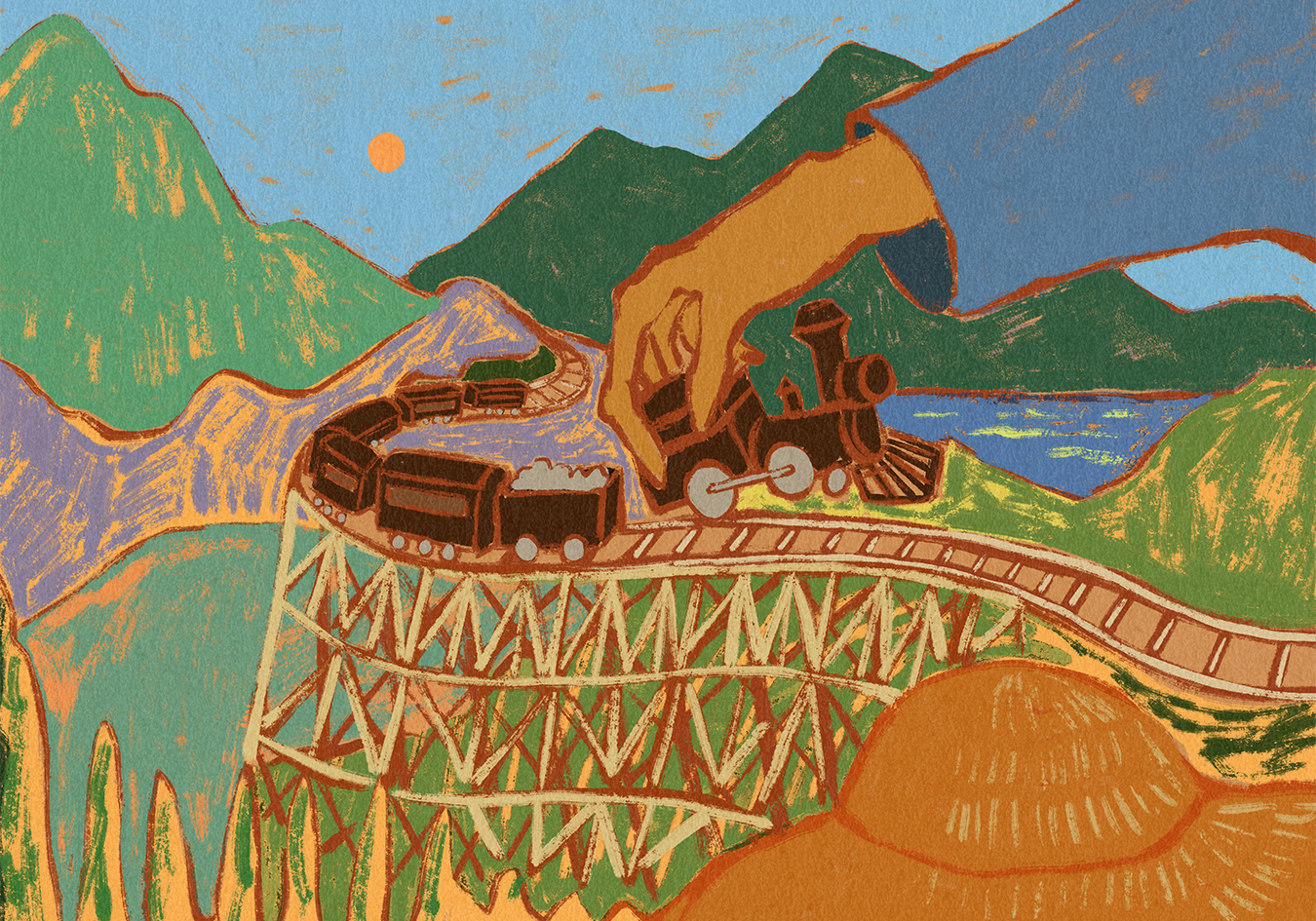
Illustration by Arty Guava
I
All the landscapes I have ever seen
condense into a single drop of ink,
merging water and sky into one.
Facing the sea
and the slow ignition of sunrise,
I make a vow:
to inscribe all things between heaven and earth
into the treasury of pictographic characters.
It was his hands
that turned bone into rails—
the Canadian Pacific Railway.
He was one of tens of thousands
of Chinese labourers
brought to British Columbia
to carve the western line of the CPR
between 1881 and 1885—
blasting rock,
carrying steel through winter mountains,
dying in landslides, explosions,
disease, hunger, cold—
their names scattered
into the ballast beneath the rails.
Along those same rails,
the Rockies rush toward me.
And I, without hesitation,
draw the Yellow River and the Yangtze
from my own veins,
reuniting with the mountains
through the same blood and will.
I write in their place.
II
The beauty of pictographs
lies in imitation of things—
imitation of wood.
More than a century ago,
a piece of driftwood
arrived at the Port of Vancouver.
From it, a flag was born into air—
a leaf suddenly veined with blood,
falling through history
to tell its story.
The beauty of pictographs
lies in imitation of people.
At Canada Place,
you borrow two white clouds from the angels,
and from the railway, two bones of your kin
to serve as palette knives.
You turn toward the burning sun.
With earth as paper,
with lakes, cities, starlight, moonlight as ink,
with blood and sweat as rhythm,
you paint a vast scroll
of ten thousand miles of mountains and rivers.
Thus Canada comes into being,
joined by bone.
And looking back into the painting,
you and he have already merged
into a single stroke.
III
It is not only the phoenix
that is reborn from fire.
The heart of Chinatown
is also a piece of driftwood
that gave birth to
and nourished a dragon.
It breathes—not mythic flame,
but the Greater Vancouver Chinese Cultural Centre
hosting a forum on multiculturalism.
Descendants of the dragon
treat this day as Valentine’s Day,
carving bone and memory
into roses and poetry.
The phrases “taking root where one lands”
and “fallen leaves returning to their roots”
stretch back through railway steel
and Fraser Valley sand—
to the end of the Gold Rush,
to the beginning of migration.
Here, culture becomes a riverhead—
not fixed, but flowing,
a brightness endlessly unfolding.
At the edge of the present,
wheat awns and AI negotiate their border.
My dear, culture
is a wandering poet.
In the monologue of dusk,
strings of music drift slowly.
The sea is silent.
No West ahead, no East behind.
Night wraps everything
in tenderness and endless sorrow.
He Ping Dao (和平岛) is a Canadian poet, software developer, and petrologist based in Victoria, British Columbia. Originally from the mountainous region of Baishanzu in Zhejiang, China, he holds degrees in the natural sciences and computer science. His work explores the “pan-knowledge” intersection of scientific concepts—geology, physics, and coding—with the deep roots of classical Chinese literary tradition. Under the pen name He Ping Dao (Peace Island), he seeks to “activate” traditional imagery through the lens of modern science and the immigrant experience.
Lay Hoon, aka Arty Guava, is an Illustrator and Graphic Designer based in Vancouver. She grew up in Malaysia and spent most of her adult life in Singapore before moving to Canada. She has a Bachelor’s Degree in Bioengineering but chose to make a career switch after about 1 year of working there. Art and Design have always been her calling. She is passionate about culture, people and nature and how these themes interact. Her work is available at artyguava.com/illustration