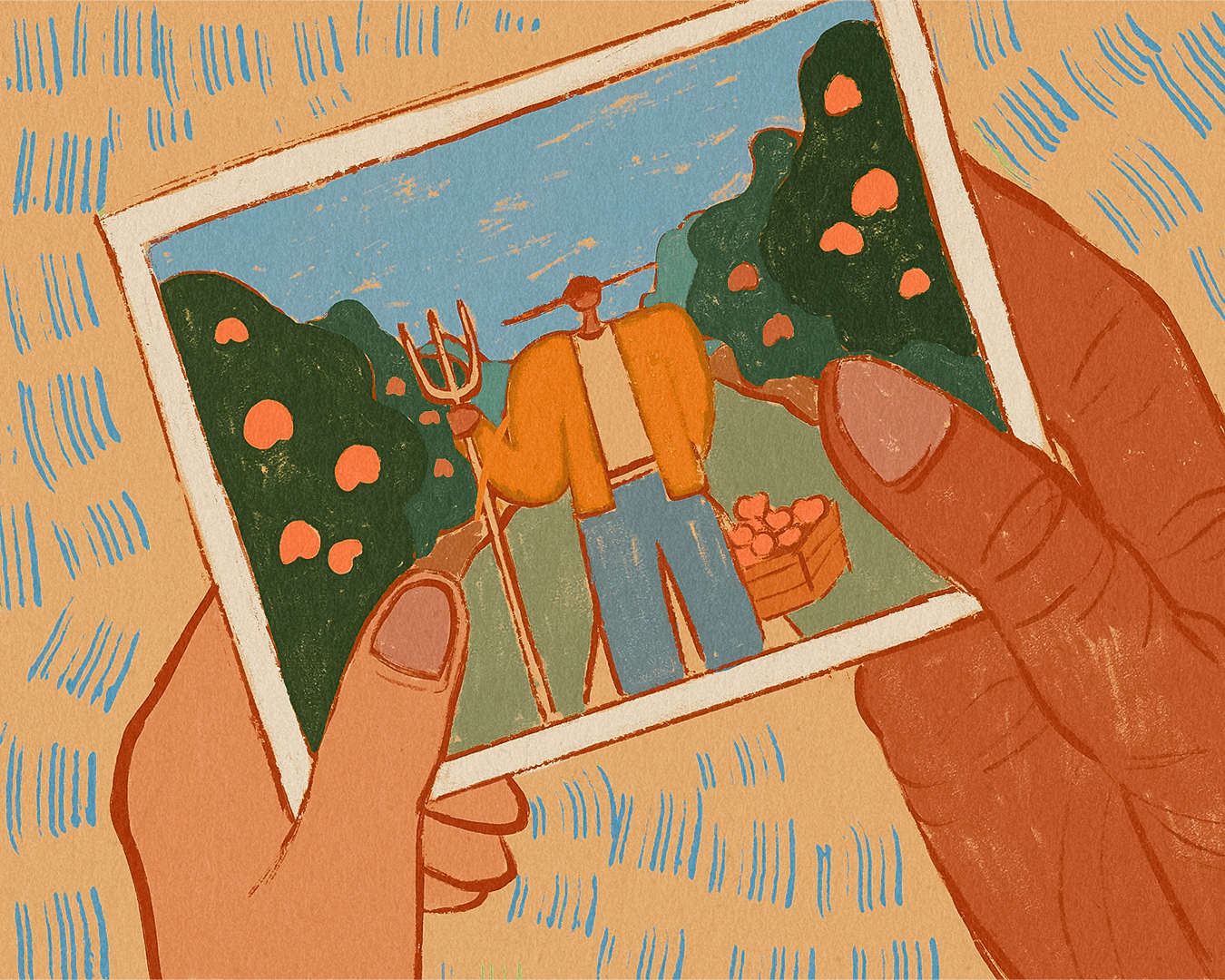
Illustration by Arty Guava
Custody
First,
misplace a word.
Not the important ones.
Something small:
the name of a vegetable,
a season,
the bird that nested outside
your grandmother’s window.
Let convenience
perform its careful theft.
Soon
you will dream
in one language
and grieve
in another.
At family dinners
you become
an archivist of fragments:
a proverb with two teeth missing,
half a joke,
the sound of your mother
counting change.
Years pass.
The language does not leave.
It sheds rooms.
One day
someone younger asks
how to say home.
You hesitate.
Not because you have forgotten.
Because suddenly
you remember everything.
The departures.
The sacrifices.
The miles hidden
inside a single syllable.
You answer.
The word leaves your mouth
slightly altered,
slightly weathered,
still breathing.
And you understand:
a language is never lost.
It simply changes
custody.
***
After the Orchard
The future arrives
in renderings.
Glass.
Light.
Young couples carrying groceries
that never spill.
Trees already mature.
Dogs permanently happy.
No one draws
what stood there before.
The orchard survives
one final summer.
Peaches hang
like small lanterns
among the leaves.
My father walks the rows
touching trunks older
than his citizenship.
When he first arrived,
he says,
the trees taught him patience.
Plant.
Wait.
Trust what grows unseen.
The city prefers
faster harvests.
Patience is no longer zoned
for residential use.
By autumn
the machines arrive.
One tree.
Then another.
Then another.
Roots lifted suddenly
into daylight.
The oldest seem surprised.
Months later
glass towers rise.
Families move in.
Children laugh.
Nothing is wrong.
Everything is different.
Still,
each spring
when evening strikes the windows,
the buildings glow
the color of peaches.
For a moment
the orchard returns:
not as memory,
but as insistence.
***
Cloud Archive
My niece asks
what a photo album is.
I tell her
it was a cloud
that lived in a drawer.
She laughs.
The idea feels impossible:
pictures existing
without passwords,
subscriptions,
or terms of service.
Later,
I watch her scroll
through thousands of images
of herself.
Birthdays.
School concerts.
Dogs.
Sunsets.
Evidence.
Enough evidence
for several lifetimes.
Yet she keeps collecting more.
As if memory
has become a leaking roof.
My grandmother owned
four photographs.
One survived a flood.
One survived migration.
One survived fire.
The last hangs above my desk,
yellowing into weather.
Its face is fading.
Yet somehow
it remembers more
than my phone.
My niece asks
what happens
if the internet disappears.
I think of libraries.
Ash.
The smell of paper surrendering
to flame.
Then I think of stories:
how stubborn they are.
How they migrate.
How they hide.
How they wait.
“The stories stay,”
I tell her.
“Just not where we left them.”
She nods,
accepting this
more easily than I do,
and changes her password
again.
David Anson Lee is an Asian Canadian poet whose work explores intergenerational memory, diaspora, identity, and the emotional architecture of belonging. Born on the Pine Ridge Indian Reservation and shaped by a life between cultures and disciplines, his poetry often examines how history, migration, language, and silence echo through contemporary lives. His work has appeared in numerous literary journals, including Braided Way, Eunoia Review, Ink Sweat & Tears, Silver Birch Press, Spillwords, and Ricepaper Magazine. Through lyrical narrative and layered imagery, Lee’s poems investigate resilience, cultural memory, and the forces shaping personal and collective identity across generations.