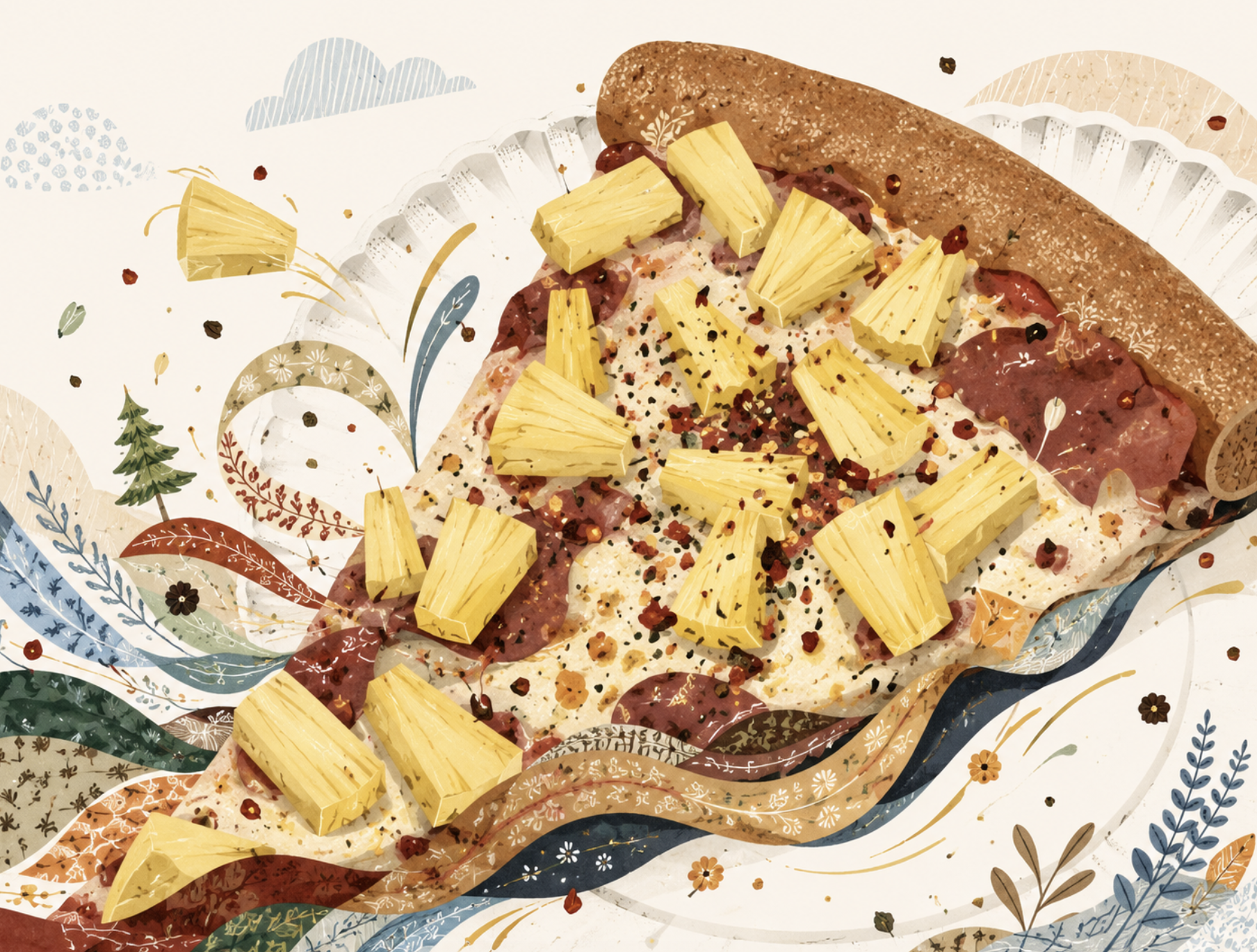
Illustration by Anna Ohura
Peter Pang has an unfortunate name, but Mr. and Mrs. Pang really thought Peter was a good name for their son. His name, though, was not really one of the bigger problems in his life. Neither is what I’m about to tell you. That is — that Peter was never allowed to eat fresh pineapple. No, I really don’t think this was a big problem, but for his mother, it was a matter of life and death. Mrs. Pang had a cousin who went to Hawaii on vacation. When the cousin came back to Vancouver, he lived for only two more days before he died. He was twenty-two at the time. Mrs. Pang said it was because he ate fresh pineapple and it killed him. From that time on, Peter could only eat canned pineapple.
The Pangs rarely ever ate pizza but, whenever Mrs. Pang looked at a menu and saw the words Hawaiian pizza, the blood seemed to drain from her face. It wasn’t because she felt that pineapple had no place on pizza. Her husband felt that way, but she didn’t. The fact that it was Hawaiian pizza — that raised the spectre that the pineapple was fresh. If it was Hawaiian, it had to have fresh pineapple, didn’t it? Mrs. Pang would ask the server if it was fresh pineapple. If the server proudly said “yes,” then Mrs. Pang said she didn’t want it.
It is no severe deprivation to grow up not eating fresh pineapple. The canned version is sweeter than the fresh version. When Peter turned twenty-two, he met a girl who preferred fresh pineapple — so much so that she would consider it beneath her dignity to touch canned pineapple. The girl was nineteen, and her name was Wendy. They had met on the University of British Columbia campus, inside the student union building, which they call the Nest, because the university football team was called the Thunderbirds, and a bird must have a nest. The building was a modernist building with clean lines, a soaring wall of glass on one side that flooded the atrium with natural sunlight and a ceiling several storeys high. Many of the food vendors were located on the bottom floor, which had tables where groups of students could sit and eat and talk. It was at a table just outside of Fresh Slice pizza where Peter saw Wendy about to eat a Hawaiian pizza. Very boldly, he approached her, crouched down beside her with his face close enough to examine the pizza at close range. He asked, “Is that fresh pineapple or canned pineapple?”
Wendy made a face before she turned to look at Peter. “Canned pineapple is gross,” she said. Then she turned to look at Peter and, for a moment, she was speechless.
“I only eat canned pineapple,” said Peter.
Wendy quickly looked away. She seemed to be examining the pizza. She lifted a slice up to her face and examined it.
“Why do you only eat canned pineapple?” she asked in a quiet voice. She was thinking of adding, Any normal person would prefer fresh pineapple, but she decided to keep that thought to herself.
“Do you want to hear a story?”
Wendy turned to look at Peter, looking rather surprised. For several seconds, they locked eyes, but then Wendy grabbed an empty chair and slid it to Peter. He proceeded to sit down and tell her the story of his mother’s cousin who died from eating fresh pineapple in Hawaii. Wendy had forgotten that she had been saving that seat for a friend who said she would meet up with her for lunch.
When Wendy’s friend arrived at the table, she found that Wendy had not saved a seat for her, but the friend was intrigued to find Wendy listening intently to a handsome and rather tall Chinese guy tell her some fantastical story about a pineapple prophecy — something about how this guy was cursed to never eat fresh pineapple for, on the day that he eats fresh pineapple, he will die. “You won’t really die!” Wendy exclaimed incredulously.
At this point, Wendy’s friend chimed in: “Listen to your elders. They know stuff that science can’t explain. If your mom says eating fresh pineapple once killed a relative of hers, then you should stay away from fresh pineapple. Don’t even touch it or you’ll die.”
Wendy had decided to trust her friend whom she later chose to be her maid of honour at her wedding to Peter. While Wendy liked pineapple, she was no more in love with it than she was in love with Peter. Thus the couple decided that no sort of pineapple — fresh or canned — would ever enter their household.
Peter and Wendy Pang became the proud parents to two boys, Adam and Joshua, born two years apart. This greatly pleased Peter’s mother, though Peter’s father warned him, “Boys will drain the life out of you in the first several years.”
Wendy was not pleased with her father-in-law’s negativity. “Why would you think that?” she asked. It was more of a rhetorical question for what she meant was, Why would you say something so absurd? As if having boys was not also life-giving rather than life-draining. As if raising boys was any more of a burden than raising girls.
“Boys are prone to danger,” replied her father-in-law. “They get into situations where they can get hurt, even wind up in the hospital.”
Peter tried to lighten the mood. He said, “Knowing Wendy and me, we won’t be raising the boys to be big risk-takers.”
“A boy doesn’t have to go looking for danger,” replied Peter’s father. “Sometimes danger finds him.”
It happened one sunny summer day. Danger did not come for Adam or Joshua, but danger did come. The family was having a picnic in a park just off of busy Victoria Drive. The boys were kicking a soccer ball around. There were a couple of Chinese seniors strolling through the park. A young Filipina mother was pushing a toddler in a stroller, when Wendy commented to the mother, “Your son is so adorable.” Peter sat on a blanket and listened as the two women chatted. A man arrived whom Peter and Wendy assumed to be the father of the toddler. When the man picked up the boy, turned, and hurried away at a brisk pace, the mother screamed.
Peter realized that the man was not the father, so he bolted to his feet and ran. He had thought, just for a split second, of tackling the man, but he could not risk hurting the boy. As Peter was within arm’s reach of the man, he decided to take the risk. He lunged forward and grabbed the man’s waist to wrestle him to the ground. The man fell to his knees, but he struggled to hold onto the boy while trying to free himself from Peter’s grasp.
Ultimately, Peter’s grip was so firm that the man dropped the boy onto the grass and punched Peter in the side of his skull. Peter still would not let go. The two men wrestled, but the stranger continued aiming his fists at the side of Peter’s skull. “Let me go!” shouted the man, “or I’ll punch you all the way to Neverland!” Finally, Peter released the stranger and the stranger, in his haste, got to his feet and ran away. Wendy was distraught. Peter appeared to be unconscious for a minute, but her cries and her touch eventually brought Peter back to the land of the living.
Wendy was more traumatized by the incident at the park than Peter was. She did, however, suspect that the opposite was true. When she lay awake at night, she would hear her husband talking in his sleep. Whoever he was talking to in his dreams, he really seemed to have a volatile relationship with that person. His conversations in his sleep were animated. Sometimes he argued with the other person, but sometimes he spoke affectionately. The only line he consistently seemed to say was, “No, I won’t eat the pineapple.”
Were the dreams really about pineapples? Who was trying to persuade him to eat pineapple? Whoever it was, it was someone who aroused deep passions in him.
“Who are you talking to in your dreams?” Wendy would ask her husband when he awoke.
Every time it was the same person. Peter reported seeing a boy on a tropical island. The boy didn’t always come to him right away. He was often playing with other boys but, whenever this boy saw Peter, he would come running to him. A pineapple would magically appear in the boy’s hands, and he would say, “You should eat some pineapple and go back home.”
Peter explained to Wendy that, in his dreams, he would always tell the boy about his mother’s story about the cousin who ate fresh pineapple in Hawaii, went back home to Vancouver, and then died. “Do you want me to die too?” he would ask the boy.
The boy would simply laugh and shrug. “You’re not going to die,” he would answer. “You’re going to live! You just can’t live here.”
Then Peter would ask the boy, “Where am I?”
“You’re in Neverland!”
Wendy did not like the sound of that recurring dream. She questioned Peter thoroughly on the appearance of the boy. Peter replied that the boy was Asian, but he had dark skin, more Filipino or Vietnamese than Chinese. “He looked like a younger version of that guy who punched me at the park,” he said.
Wendy was satisfied that the boy could neither represent Adam nor Joshua. “You should see a counselor,” she said. She was convinced that the dreams were brought on by the incident at the park off Victoria Drive.
“I don’t need counseling,” he said. “I need a life without dreams.”
The dreams were always the same — the boy coming up to Peter with a fresh pineapple, saying, “You should eat some pineapple and go back home.”
Peter always replied, “Do you want me to die too?”
But one time — just one time — he decided to say something different. He said, “Give me a Hawaiian pizza, and I’ll eat it.”
Magically, the pineapple the boy was holding morphed into a Hawaiian pizza. The boy held it as high as he could and said, “Look at it.”
And Peter lowered his face almost to the level of the pizza, close enough to examine every detail of the pizza. His eyes were drawn to the chunks of pineapple on the pizza.
“Pick up a piece of pineapple and eat it,” the boy’s voice said. “You promised.”
So Peter picked a piece of pineapple off the pizza and ate it.
The young, dark-skinned Filipino man sitting at the table in front of Fresh Slice pizza asked, “What do you think?”
Peter paused to look at the stranger for a moment. He had a funny feeling of deja-vu, as if this moment had happened before, but with a different person. “Was it a girl before?” he wondered. The thought had flashed in his mind for a split-second. Immediately, his attention snapped back to the Filipino man sitting at the table, and he also looked familiar. Peter now felt as if he had encountered the stranger in a park before.
“It’s canned pineapple,” Peter concluded.
For a split-second, Peter seemed to catch the stranger flashing a smile, as if he knew a secret. Maybe he even winked.
He thanked the young man and continued walking through the Nest. He walked straight out into the open air, took a deep breath, and proceeded to walk toward the UBC Bookstore. “I didn’t die,” he said quietly.
He wondered why he said that. Of course he didn’t die. It was canned pineapple, not fresh. Surely it was canned. His mother’s prophecy still stands. Peter had never eaten fresh pineapple, and surely he would not die. He lived a good, long life. He lived as a happy, independent bachelor. He traveled the world and slept with many women, some of whom had wanted to settle down with him, but the man could never be tied down to one place. When friends asked him if he was happy with his life, he would reply, “I’m living the dream!”
He did remember, vaguely, a time in his life when he had a recurring dream that he was married and had two sons, but he told himself that those were only dreams and nothing about them matched the reality that he lived. And he lived life fully. The spirit of the boy in him was determined to never grow into an old man, but Peter did eventually grow old. Peter would die peacefully in his sleep in a nursing home. In his golden years, a caring niece would visit him occasionally, bringing food, but she never brought him anything with pineapple in it. She knew from family lore that Uncle Peter was the man-child who was determined to never grow old, never settle down, and never eat fresh pineapple and die before his time. This niece had listened to Peter tell his life story numerous times. She carefully noted every detail of his story, even the dreams he recounted to her, and this niece is a reliable witness that these things really did happen.
Randal Chin is a short story writer and lifelong resident of the east side of Vancouver, BC. His parents were immigrants from Guangdong, China. He is currently a student at Regent College in Vancouver, working toward an M.A. in Christian Studies. He has had short stories published by the Regent College student magazine. He was inspired to write short fiction because of the writing of Haruki Murakami. He also counts Flannery O’Connor and Franz Kafka as his literary influences.