 Eating bitter, Siu-Ling reminds herself, is the one true path to greater glory. Or so the ruddy-faced nuns at Sacred Heart tell her.
Repeatedly.
But as she digs the blunt end of her pencil into the soft flesh of her thigh — a desperate attempt to prise open the shuttering curtains of her eyelids — she wonders what harm could come from laying her head down to rest, only for a moment, against the slanted desks of the convent school study hall. Pressing one smooth cheek against rough wooden grain.
The whirring overhead fan prods sluggish air from one corner of the room to the other, meeting only resistance from the trapped mid-autumn heat. Sagging adolescent girls wilt around her like spent peonies. A sultry blanket smothers the city, in a deceptive lull, as the coming typhoon gathers off Hong Kong’s ragged coastline.
Her head bobs slightly, as if trapped between a stone anchor and the glass fishing floats that wash ashore during the storm months. Round, green orbs that dip over scudding waves; sea grapes offered up to Mazu. Her trigonometry textbook shifts in and out of focus, and a sobering thought prickles along her subconscious. She wonders whether they will raise the storm signal early, shutting down the trains.
Sister Teresa’s returning heels clack their way down the tiled hallway and a rippling current electrifies the rows of uniformed students. Lines of toppled dominoes righting themselves by an unseen force. Jolting upwards, she jabs her bruised leg again with the hard nub of her pencil eraser and straightens her back to a ninety degree angle — the sacred and spiritual geometry of the Catholic school divine.
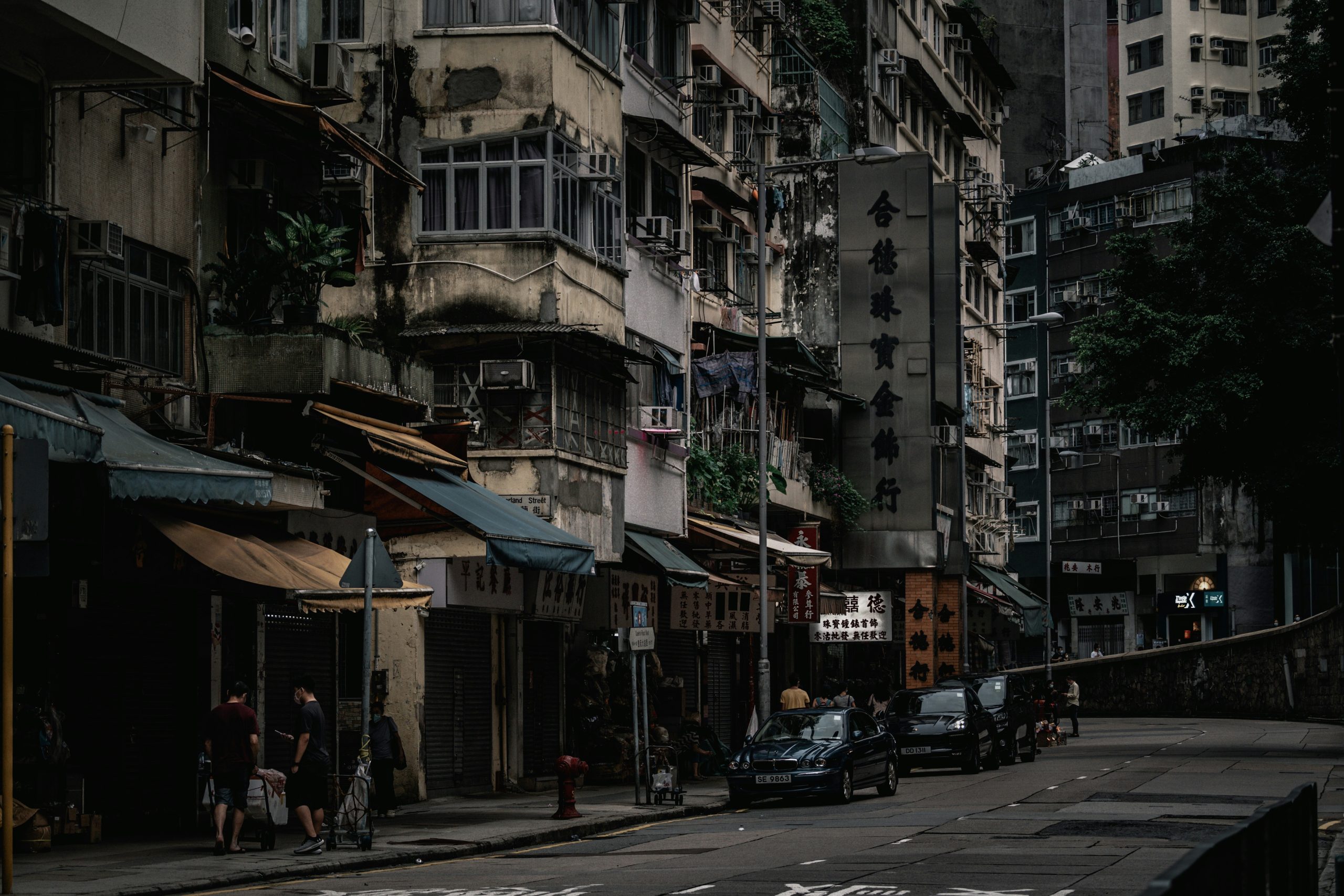
Lessons finished, Siu-Ling waits until the tram is off to a shuddering start before she dares to loosen the tie that pinches beneath the starched collar of her uniform. She leans heavily into her seat, watching the black shadows of bodies flicker against the stark white walls of colonnaded buildings and wide, terraced verandahs. The metal tram clacks its way past rows of storied shophouses, finally weaving through a shaded forest of tenement blocks, where the traffic-congested air has smeared a dark streak, like a water line, along the bottom row of charcoal-tinted windows.
She tilts her head up to the sky and silver flashes overhead, blocking out the bright strip of blue between worn-down buildings. Laundry hangs limp along bristling bamboo poles above. Shrieking voices echo down over the screech and rattle of the tracks, as children race along the chipped tile rooftops like feral hunters, chasing the rising metallic PanAm bird through a jungle of aerial antennas and corrugated metal sheeting.
Something in their wild pursuit sparks a flame of courage within her. She jostles her way down the aisle and hops out the doors as the tram begins to pull out of its station. This stop is closer to her flat, but she always disembarks at the next, despite the time it adds to her commute. At first, shocked at her own impulsiveness, she lets out a little laugh. But a slow, undulating movement out of the corner of her eye turns her forearms to chicken skin.
The beady glass eyes of a snake — or half a dozen snakes, now that she looks more closely. Shiny, yellow-banded scales press against shabby boxes of chicken-wire mesh, their forked tongues testing for gaps. Like the serpent in the painting that hangs in the school needlework room, ground low beneath one of Mary’s little white feet.
The sour tang of acid fills her mouth but she forces herself to swallow. It’s Friday evening, she tells herself. Her mother will already be at the small, mostly empty apartment that Siu-Ling shares with her sister Yin-Yin, cooking and packing food for the week into their tiny refrigerator. The wailing lilt of Cantonese opera trailing down the building stairwell from the tinny kitchen radio. She wants to make the most of this time, when the flat feels full and noisy. Lived in. Whole. The salty, savoury smell of home-cooked food seeping into the curtains and the concrete pores of the walls.
Determination courses through her. She propels herself forward, one foot in front of the next, marching in time to the thundering drumbeat of her heart.
A white-haired shopkeeper comes into view, his arms extended at his sides, forearms laden with writhing snakes. He lifts them high for an elderly woman to select, pointing out the best options for her ailments — rheumatic disease, joint health. Warming blood and decreasing dampness in the spleen. Behind him, dozens of locked wooden drawers with brass handles line the walls, filled with his more dangerous specimens. Siu-Ling feels her stomach somersault as she elbows her way through the busy crowds.
But no fangs dart out towards her, not even a hiss. Their tightly coiled bodies lethargic in the late afternoon sun. She heaves an audible sigh as she crosses the street and skips into the entryway of her four-storey walk up, taking the stairs two at a time before clanging open the metal grille and shouting out a greeting. Mama. I’m home.
A statement or a question? She wonders.
“You’re back,” comes the response, amidst a clatter of pots and pans.
As expected, her mother is busy cooking in the cramped, steam-filled kitchenette. A bowl of crimson-skinned lychee rests on the fold-out dining table, branches of bougainvillea spilling out from a vase beside it — pink fluffy clouds like the cotton candy her father had bought for her once at the night track, great brown racehorses thundering past.
Yin-Yin is in her bedroom talking to her boyfriend on the phone, her voice muffled; the curly pig-tail of the cord pulled taut beneath a crack in her bedroom door. Siu-Ling slips her heavy school bag from her shoulders and watches from the doorway as her mother cracks an egg on the edge of the counter and deftly places it into the center of a steaming pork patty. She tucks a dishcloth around the rim of the steamer to seal it firmly beneath its lid. A pot of clear broth bubbles on the second burner. Siu-Ling’s mouth begins to water.
“Go set the table,” her mother tells her. “And tell your sister to get off the phone.” She does as she is told. Neatly, she lays out three bowls and sets of chopsticks. The fourth place remains empty, as usual. Her father rarely takes the train down to visit. Instead, at the end of term, she’ll make the two-hour trip with her sister to stay with their parents and younger brother at the Teacher’s College staff dormitories, dividing up spots between the two small rooms to sleep between one temperamental AC unit.
A warm evening breeze blows through the open window, carrying the heavy scent of flowers across the room. How long ago had it been when she had laced her small fingers through her father’s larger, more calloused ones. Papery flowers floating down around them in the night air as she rested a chin on the cool metal railings of the track, eating spun sugar. Pink teardrop petals against the whiteness of her father’s embroidered cap — a single point of brightness bobbing in a surrounding sea of dark hair. A racehorse passed by, whickering and skirting the rails towards the starting gate, its chest and neck slick with sweat, eyes rolling wildly, foaming at the mouth. Threads of spittle trailed across her sleeve, making her grimace. She doesn’t remember which horse won that night. Just the smell of the flowers and the soft warmth of her father’s hand.
Her mother places the steaming platters of food onto the vinyl tabletop in front of her. “I’ve brought you a treat,” she says, lifting the lid off a tin lunchbox to reveal juicy slices of roasted duck, along with slivers of crunchy green onion and hoi sin sauce — her favourite. “Now where is your sister?” she complains, scooping soft white rice into their bowls. “I’ll not wait for her, you know.”
But Yin-Yin appears as soon as she hears the clatter of serving dishes.
They sit together, the three of them, at the four-sided table, gently coaxing the succulent meat into little pancakes before stuffing them into their mouths. Siu-Ling closes her eyes at the salty-sweet explosion across her tongue, savouring the warmth spreading through her belly.
She imagines someone across the street, looking through their square lit window at the family scene within. Like one of those European paintings in her art history textbook. “I spoke with Sister Agnes on the telephone today,” her mother begins, after noisily sucking the meat off a piece of bone. She deposits it, clean and glistening, on the plastic tabletop in front of her.
“She says you will take the sacrament next week, at the end of your first term.” Siu-Ling chews deliberately, keeping her eyes on her food.
“What will baba think,” she says aloud, after a long pause. Using her chopsticks like scissors, she divides the pork patty into sections and serves it to her mother and sister before herself.
“He’ll be fine,” her mother replies, spitting more bones onto the table. “He shouldn’t let this kind of thing affect him anyway. This is about education isn’t it? Not really about spiritual matters.” They continue their meal in silence, as they often do at the start of her mother’s visits, until their first bowls of food have been emptied.
“Now tell me what kind of things you’ve learned this week,” she asks, jabbing a toothpick between slightly yellowed teeth.
Siu-Ling covers her lessons in arithmetic, typing, calligraphy and moral education. Yin-Yin brightens as she details the outfits chosen for their upcoming fan-dance recital: pale-green silk dresses with black fitted vests and a spray of pink plastic flowers woven through hair buns.
Her mother nods in approval. “You can perform again for your brother and father when you are back home for the holidays.”
As they clear away the dirty dishes, Siu-Ling lines the chopsticks up in her fist so that none of them stick out further than the others. She drops them into a sink full of soapy water and wipes them with a rag.
“What do we have to do for this sacrament?” she murmurs, almost to herself. Her mother stacks a pile of clean bowls together, placing them back on their shelves before answering.
“I think it has something to do with eating a body.” She wrinkles her nose at the thought before shrugging her shoulders. “I don’t understand it, but that doesn’t matter. It’s expected of you.” She tugs at a clean dish rag hanging on the line outside the window ledge, stiff little ghost shapes pinned in a neat row. “Just remember, you earned this. No need to think about it too much when you worked so hard for this placement. All you have to do is swallow it down.” And in half-hearted consolation, she adds, “I think it’s some kind of cracker.” Siu-Ling considers all this as she wipes down the foldable table and collapses it to neatly tuck behind a shelf. She stacks the stools and places them in the corner, freeing up their living space again. She dries the rest of the cutlery carefully, placing them individually back into their drawers, as if her deliberate movements might slow down time — and their inevitable separation.
Her mother had scrubbed and tidied the little flat; the bathroom tiles were scoured, school uniforms crisply folded and placed on aired-out bedding. A week’s worth of household chores completed in a single afternoon.
When it is time to say goodbye, they repeat the same parting scene, word-for-word, that they enact every week.
“See you next Friday,” her mother says. “Be good, study hard.”
“Yes, mama,” they dutifully reply.
She watches as her mother turns to go, memorizing her movements. Her striped cheongsam tapers elegantly at the waist, one arm turned up gracefully as she carries her empty market bags in the crook of her elbow. This time, though, she notices pinched lines around her mother’s red painted lips, a shadow under her eyes that she hasn’t noticed before, beneath the circle of fluorescent light.
By the time Siu-Ling pulls the heavy gate across and bolts the inside door, Yin-Yin is already back in her room, music blaring. She plucks a plump lychee from the bowl and finds her sister lying on her stomach flipping through a fashion magazine, legs kicking in time to a new rock’n’roll song on the radio. Siu-Ling perches at the end of her sister’s bed, looking at the magazine over her shoulder. The western models wear white fitted pantsuits and denim bell-bottoms, flaring wide over unsteady looking platform heels, a stark difference from her frumpy school vest and below-the-knee skirt.
“Do you think baba’s god will forgive us?” She voices her question to the back of her sister’s curly black hair. Her fingers unconsciously twisting at the kitchen cloth still in her hands. “Maybe.” Yin-Yin hums along to the radio as she deliberates. “Or maybe not.” She shrugs, tilting her head to better admire a collared blouse in a bold orange-yellow print. “What does it matter anyway? Mama will only end up going to the temple to pray for your exam results either way, and baba’s god has never had any problem with that, has he?” She tears out a page from the magazine to tape up onto her wall.
“Besides,” she pauses, giving it a little more consideration. “Isn’t it better to try them all out and risk displeasure than bet on the wrong horse?”
She gives Siu-Ling a wink. “The way I see it, if it amounts to nothing, all you have to do is eat a wafer.” She shrugs. “Can’t taste that bad.”
Peeking through the barred windows, Siu-Ling watches as her mother slips out from the main entry and walks down the street in the failing light. She stops to unfurl her umbrella against the beginnings of heavier rain to come. They’ll be stuck inside the apartment all weekend, waiting for it to pass. Her mother’s head turns from side to side as she checks for cars, but she doesn’t glance backwards, towards the young girl watching her retreating figure in the darkening night.
She tries to understand her mother’s choices as she peels back the rough skin from the lychee. How doing the hard things now will make for a smoother, easier life in the future. But as she takes a bite of the soft white fruit her mouth puckers, shocked by an unexpected tartness. Rust-coloured streaks of rot spread out across the flesh from the glossy seed within.
She wonders whether the sweetness of the sacrament will be able to mask the bitter taste coating her tongue. Or the aching loneliness pulling at her soul.
Kim Campbell-Sullivan is a Chinese-Canadian commercial & lifestyle photographer, illustrator/painter, qualified visual arts teacher and an aspiring documentary storyteller and writer. Having lived in Hong Kong for over 15 years before returning to Canada, and as a new mother, her work often explores the complex themes of belonging, mixed ethnicity and the intergenerational passing of cultural heritage from mothers to children in the Chinese diaspora. Kim is currently working on a documentary and a fiction novel that explores these themes with grand funding from the Canada Council for the Arts.