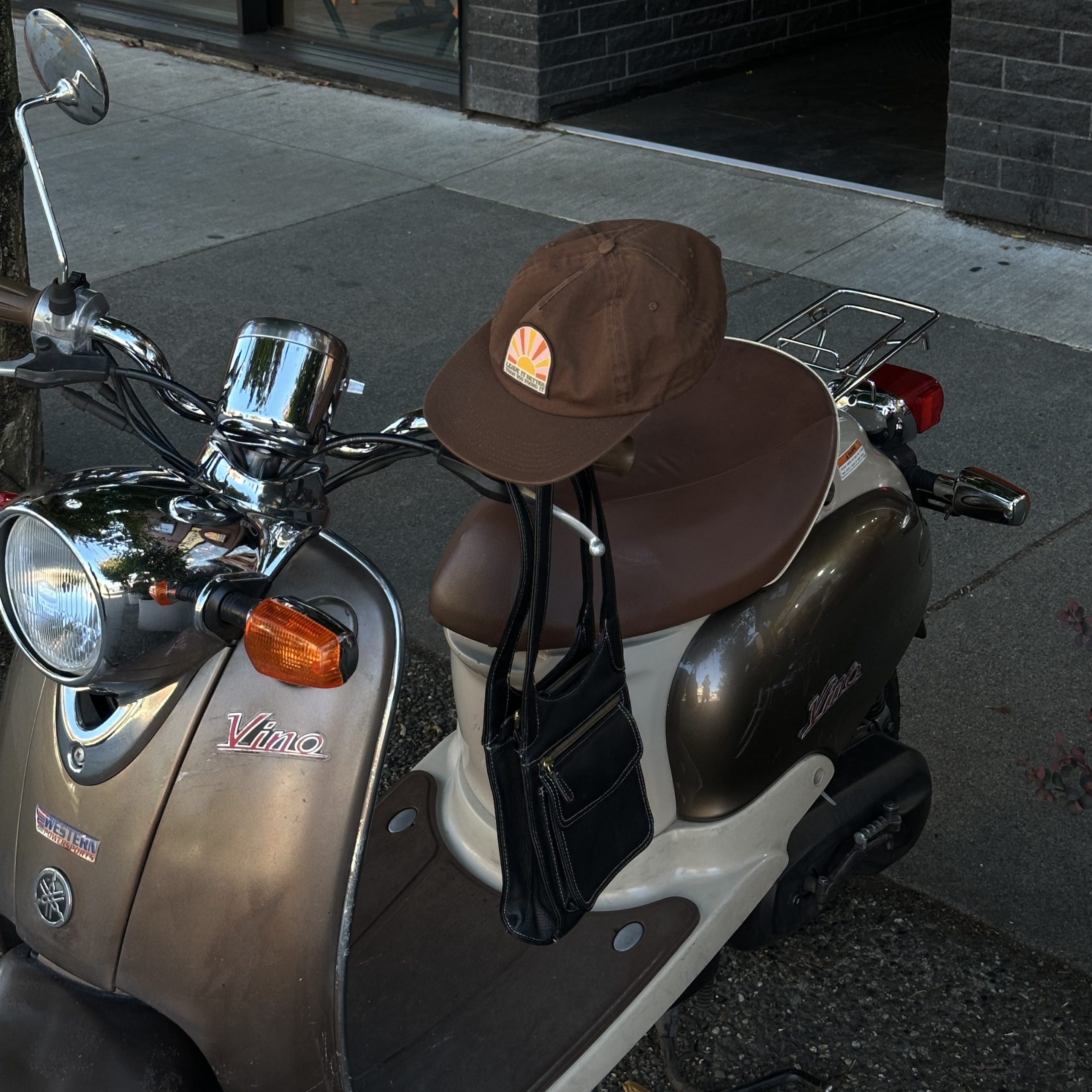
Photo by Brian Nguyen
I have a running list:
I love the planet too much,
I want to ride a moped instead,
I think cars are ugly,
I know I’m going to hit someone,
I get easily distracted,
Or quite simply: I don’t know. My younger sister finds it strange, since I’m the one who “wants to
get out of the house more than anyone.” Which is true.
What I don’t say is:
My grandfather, 할아버지, tries his best to teach me: And this is one of the last chances I see him
before university. He’s getting older every year.
When we drive, we often go to the garden. There are fresh fruit and yogourt pops—Bursting
bright grapevines draped over a home-made trellis, green light filtering in through the leaves. My
grandparents are better lesbians than I am, despite being a completely heterosexual couple, because their
entire backyard is a garden (“Permaculture” before it was cool), they have a rain bucket (which my queer
friends would kill for), and at family reunion my grandma (할머니) drinks wildly and dances on the table
while my grandpa sits on the couch docile-y sipping his Ginger Ale in a way that screams butch-femme in
a way I can’t describe.
What I also don’t say is this: My father’s grandmother, my great-grandmother, is the first family
member I saw die, and it’s far too easy to picture my grandparents joining her. As a particularly cruel
reminder of this, me and my grandfather drive to drop off fresh, culturally-specific 깻잎 leaves to a
pleasant but suffocating retirement home. For Korean seniors (or just one, I wasn’t really paying
attention), and again they’re better lesbians than me because that screams grassroots organization. More
importantly, I am reminded that soon, my grandparents may also need to go to a nursing home, retirement
home, palliative care. Who will visit them when they do?
Sometimes, I look at the grey hairs on my grandparents’ heads, and feel comforted that they still
have hair. Sometimes, I look at the grey hairs on my parents’ heads, and I wonder what’s happening.
Sometimes when I drive I don’t want to accept that I will be taking their place, soon. That I will have a
child. Or adopt one. Or get an IVF. Or something.
And that there will be a day where I’m driving and someone asks me for my license in the
smoldering wreckage of a car accident, and there will be no home to call, no parents to visit me in the
hospital. Will my children visit me? Will I have any at all, that would still want to?
People say that cars are a symbol of “teenage freedom”: All it reminds me of is hurtling down at
speeds unknown to me, too fast to be true, to a destination that only reminds me of soap and plastic
flowers in the funeral home. By not being able to drive I can, somehow, prolong the inevitable.
My great-grandmother didn’t say much while she was alive. She was already “gone” by then. My
grandparents, in my mind, will join her in that land, cross that invisible threshold, once we stop talking.
These driving lessons are a way to keep talking. Even if it’s about that stop sign I conveniently missed.
Which I genuinely didn’t see. Honestly.
I’m better at driving now. I drive my siblings to work, and while I still fail to slow down
adequately at yellow lights, and I don’t always check my blind spots: I haven’t gotten into an accident yet.
And it’s terrifying, in a way that my sister couldn’t see when she wondered why I didn’t want to learn:
That, more than anything, it reminds me of control that I will never have. Of growing old. Of that
mouth-drying memento mori.
But, similarly to the reasons I cannot drive, I have a running list of reasons why I should improve:
First of which is the smile, the awkward but endearing two-palm high-five, the pride that I know my
grandfather has that, like he has for at least half a dozen of our family members, he has taught someone
else to drive. Which may mean something. Which may not.
Maybe I’m the only thing my grandparents will pass down.
Maybe I’m avoiding this fact, instead of doing what I can to reclaim the language, visit the
homeland, find the relatives we haven’t seen.
Maybe there’s still time, and that by trying to stay a child, I would be giving up.
Maybe–
I’ll be turning twenty, in the winter of next year. And I’m not alright with it, of course. But the
stick is there, and the car is there, and the road empties out into the rest of my life.
Maybe, all I can do is put my foot on the pedal.
A. S. Ko is a writer whose pen name is unfortunately similar to a car brand, and who has been previously published in ALOCASIA, the Quills and Keyboard Writing Contest, as well as various other publications. You can find the author at https://sangyongko.carrd.co/.
Brian Nguyen is a visual storyteller whose creative path has taken him from Hanoi to Busan to Vancouver. Recently joining Ricepaper Magazine as Visual Editor, Brian brings a fresh and dynamic perspective shaped by his cross-cultural journey. With a background in Professional Communication and a passion for photography, he believes his mission is to connect with people—visually and emotionally—through stories that uplift, encourage and humanize. For Brian, visual storytelling isn’t just about aesthetics, it’s about reaching people where they are and making them feel seen.