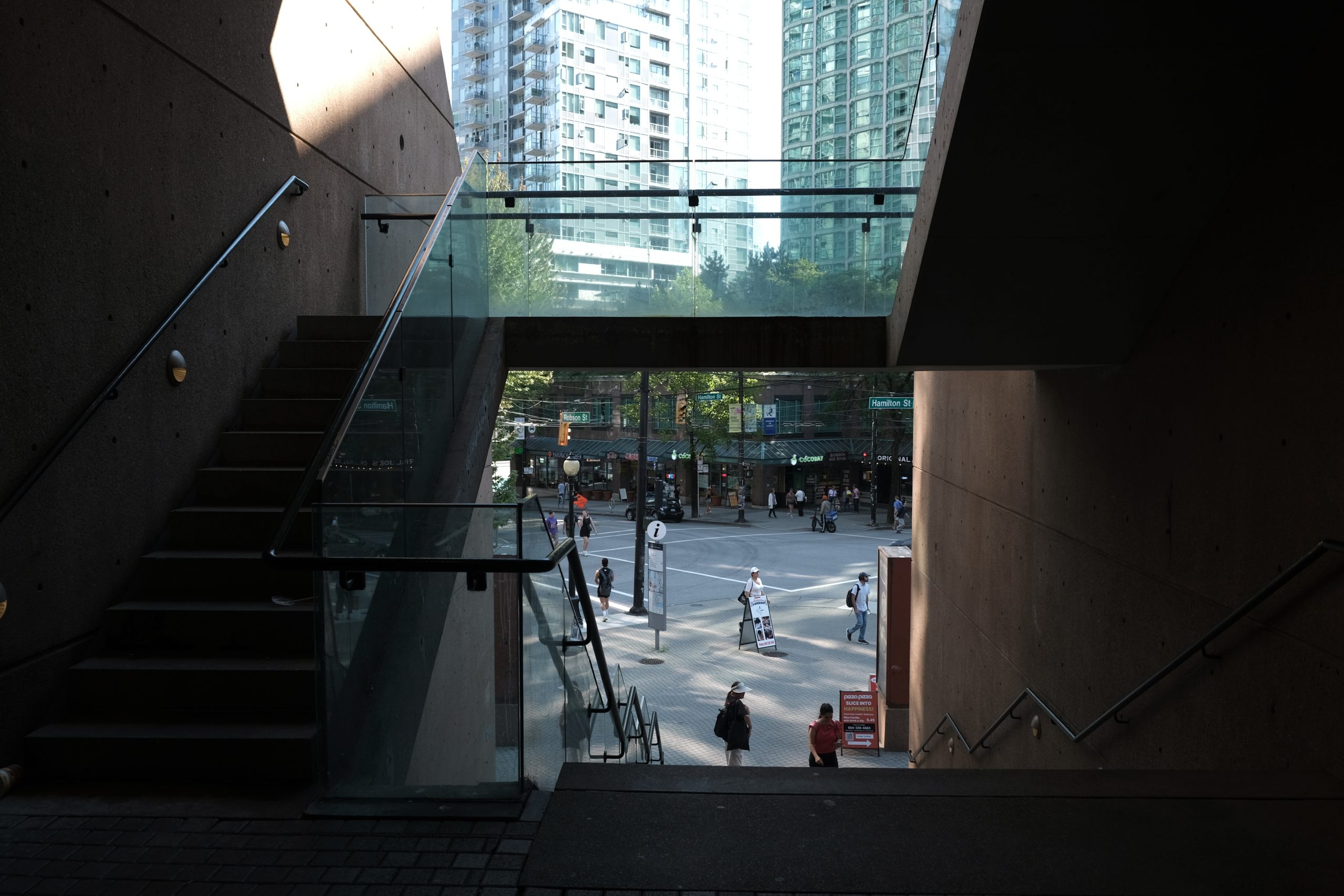
Photo by Brian Nguyen
Hello? Can you still hear me? You said you wanted to know why your family left you in New York. Are you calling from there now? I’m sorry, these old Shanghai lines cut out all the time. No, don’t hang up. I want to answer. Only, it’s hard—you grew up on my knee, and then I never saw you again. But I can do it. Where to start? Stories always begin with firsts, don’t they? Well…
It’s autumn when the first skyscraper breaches the clouds.
Your uncle is responsible.
He wants to model the Shanghai skyline after New York, he says. Never mind that by this point Shanghai has far outstripped New York, assuming height is the measure of best.
As a thank you, the Ministry of Development awards him three floors—the seventieth, the seventy-second (the seventy-first was bestowed upon the head of Renji hospital some decades ago), and the seventy-third.
Fifty more teeter above, as if kowtowing to passersby. They offer perspective, your uncle claims, that there is always someone above, always someone below.
You thought you would inherit a floor, just through proximity. I remember your plans—stairs, directly to the other floors, so you never miss family breakfast. I think you come to see us every summer, mostly out of love, but a little out of a desire to stay top of mind.
You haven’t visited in some time. I kept one of your uncle’s letters to you. Do you remember him?
(I’d forgotten that you don’t read Chinese. I’ll think about how to translate, and we’ll continue in the meantime.)
As I was saying, the seventieth floor becomes an office. It’s the twins, your cousins, who take to the seventy-second and seventy-third floors. In them they construct a library; a playground, as they, like your uncle, are forward-thinking; and a garden. The garden is the most ridiculous. Crammed within are various biospheres, from desert to swamp, tundra to savannah.
At first they leave it at that.
Just the flora.
But then you visit, and every day you ask Zihan, the boy cousin, where are the tigers? Where are the tigers, Gege?
He doesn’t have the heart to tell you that tigers don’t live in the savannah, sweetling. They can live in rainforests. Mangroves. Even the taiga. Most anywhere in Asia—only not the savannah, which doesn’t exist in Asia at all.
So he makes the mistake of saying that there’s one tiger, and that tiger is sleeping. She’s sleeping, Meimei, and we can’t wake her up. But if you’re good—if you finish your homework—I can show you her den.
Let me tell you, I’ve never seen you write so fast. The characters are all wrong, but you try your hardest. You never did manage to get “I” right.
I’ll describe what you wrote:
手戈
And this is what is correct:
我
Do you see the difference?
Every stroke matters. The order of them, too. For aesthetics and muscle memory, yes, but also because writing out of sequence confuses modern input systems.
In any case, because you put the effort in, Zihan carries you into the savannah, past parched earth, through the elephant grass, and under the shy crowns of the baobab trees.
Look, Meimei, he tells you, pointing. Do you see? There—
And here he takes your hand while he shoulders your weight. He and you wave, together, at a mound of dirt that peeks through the bramble.
There’s her head, he nods with his. And her ear. Her tail, there, there—no, you aren’t looking in the right place. Yes, good.
Wow, you say. A real tiger.
You’re satisfied.
***
In the coming weeks, it’s Ziyue, the girl cousin, whom you pester. Gege has left town with your uncle, off to New York on one of their regular trips.
Jiejie, you say, tagging along as she passes windows I clean. Outside, the people are small. Jiejie, I want to learn Mandarin.
No, you don’t, Ziyue says. You only want Gege to show you the tiger.
I’ve already seen the tiger, you argue.
Yes, Ziyue says. And now you miss her, don’t you?
Wo bu miss her, you say. (No, I don’t.)
Ni bu xiang ta, she corrects. (You don’t miss her.)
Wo yao xue zhongwen, you insist. (I want to learn Mandarin.)
You have admitted to me in private, by the way, that before Zihan left for New York, he persuaded you to study by saying that the tiger speaks only Mandarin.
Day in, day out, you’re Ziyue’s shadow.
That means taking every chance to speak—and especially on the landline, where you can hear full conversations play out.
Wei? Ziyue asks. (Hello?)
Wei? you say.
Wai mai, a man answers. (Delivery.)
Wai mai, you say.
Bie nao le, Ziyue says. (Cut it out.)
Bie nao le, you say.
Sha ya ‘bie nao le,’ bie nao le, gou pi, the man says. (What do you mean cut it out? Piss off, you cut it out.)
The line disconnects.
***
By the time Zihan returns, all three floors are in disarray.
Ziyue apologizes to me—with you on her heels, mess is inevitable. She doesn’t
even know how you do it. But I do. Whenever I mop the edge of the savannah, there you are, sneaking dirt from the garden into other rooms. You say it’s because the tiger can only live in nature.
Dao ye bu cuo, Zihan tells Ziyue. Shengyi bu hao. (It’s just as well. Business isn’t good.)
Ni shenme yisi? Ziyue asks Zihan. (What do you mean?)
Aba tried to develop another skyscraper—out in Wuxi—but the locals want him gone,
Zihan says.
So? The focus is Shanghai anyway, isn’t it? Ziyue answers.
No, Shanghai was just the first, Zihan says.
Silence.
We’re going to have to give up the seventy-third floor, Zihan tells her then. Sublet, for now. That’s the best thing for us. Aba has a friend in the States. Did you know he funded that big building in Manhattan? The one with the Chippendale top—
Let me guess. We’re giving it up to the Chippendale guy? Ziyue interrupts.
Silence.
Ge, Ziyue continues. That’s where the garden is. Meimei loves that garden. She’s been studying so hard, just so you can take her to see the tiger.
Zihan nods.
I know, Zihan can only tell her, in the end.
***
The construction begins almost immediately. The Chippendale guy lives in New York, so he hires local hardhats. They work nearly as hard as you did while Zihan was away. They tear down the desert, the swamp, the tundra.
The desert and the swamp come down without much trouble. The workers have seen both terrains before, having traveled as far as the borders of China.
The tundra is different.
It thaws too quickly, damaging not just the floor it sits on, but all the ones below.
The phone calls are endless. Ziyue fields them all, with you to assist.
Ni zhexie xiang xia ren, fa mei le ni daodi guan bu guan? the doctor on the seventy-first floor complains. (Stupid country folk—do you even care about the mold?)
Dao qian, Ziyue says. (I’m very sorry.)
Bie nao le, you say. (Cut it out.)
The workers scramble to contain the damage.
When containment fails, only one solution remains:
Demolition.
***
As a favor to Zihan, the workers preserve the savannah in those last days.
Every morning, he carries you on his arm, past the plastic-lined floor, through the paint buckets, and under a ceiling networked with wires.
When I come here to live, you say, can the tiger stay with me?
Oh, Meimei, Zihan says, I don’t think so. The tiger is used to her den.
But I’m building stairs between you, me, and Jiejie, you say. The tiger can visit her den whenever she wants.
Maybe, Zihan says. Maybe if you’re extra good. But shh, now–look!
Where? you ask.
There, Meimei, he tells you, pointing. Don’t you see? She’s sleeping.
Laohu genben bu zai. Ta mei fa shui jiao, you say, stubborn. Shei neng zeyang shui? (The tiger’s not even here. And she couldn’t be sleeping. Who could sleep like this?)
Oh, he says. Your Mandarin’s so good now. Proud of you, Meimei.
Pian zi. Laohu zai nali? Keyi gen laohu liao tian le ma? you ask. (Liar. Where’s the tiger? Can we talk to the tiger now?)
Tomorrow, he says. Tomorrow, I promise.
***
You know by now that there is no tomorrow. I carry you out that night, just before the floor gives way. You don’t remember it. Only that you wake up in New York, the tiger gone. Your uncle asked me to give you this letter if you came asking questions.
Here, I know how to translate now. I’ll read to you:
We’re sorry we left you behind.
Did you know that I was left behind, too? When I was a boy, your family sent me to live on a farm. In those days, this is how we gave back to our country. I was taught the value of hard work, so that one day, I could build something for you. For all of us. This is why I am in Wuxi, and why I put you in America.
I’m told that my buildings are houses now, like the ones in your Long Island suburbs. Supposedly they’re large. Supposedly every family has one. Every family has cats, too—like your tiger. I could only have dreamed of a future so beautiful.
I wonder if you remember your Chinese. You always struggled with the character 我. Maybe it would have been easier if I’d explained the history.
Did you know that 我 was once a drawing of a weapon (戈)? It’s only in the modern day that we added the radical for ‘hand’ (手). 我 means agency.我 means I. That is, you.
Remember that, as you go through your life.
***
You’re very quiet, Meimei. Have I lost you?
That’s all your uncle wrote. But sitting at my desk now, looking at these new houses, I realize I have something more to say. They didn’t mean to leave you. They just didn’t look back.
I know what that feels like.
When you were small, you used to ask why I didn’t have a room of my own. I told you that I liked sleeping near the tiger. But the truth is, I didn’t sleep well at all. Like you, I kept searching for the tiger. He was in my dreams—always out of reach. Always running. I don’t think he could survive in any place like New York, which isn’t Asia at all.
As your uncle says, each of us has agency. He’s chosen to move on. But I’m still here, Meimei. Just your Ayi. Your nanny, where the tiger used to be.
If someday you choose differently.
If someday you come home.
I wonder—maybe—if stories can end with firsts, too.
C.K. Liu is Chinese-American, but writes from Berlin.
Brian Nguyen is a visual storyteller whose creative path has taken him from Hanoi to Busan to Vancouver. Recently joining Ricepaper Magazine as Visual Editor, Brian brings a fresh and dynamic perspective shaped by his cross-cultural journey. With a background in Professional Communication and a passion for photography, he believes his mission is to connect with people—visually and emotionally—through stories that uplift, encourage and humanize. For Brian, visual storytelling isn’t just about aesthetics, it’s about reaching people where they are and making them feel seen.
1 comment
Poignant, haunting, beautiful.