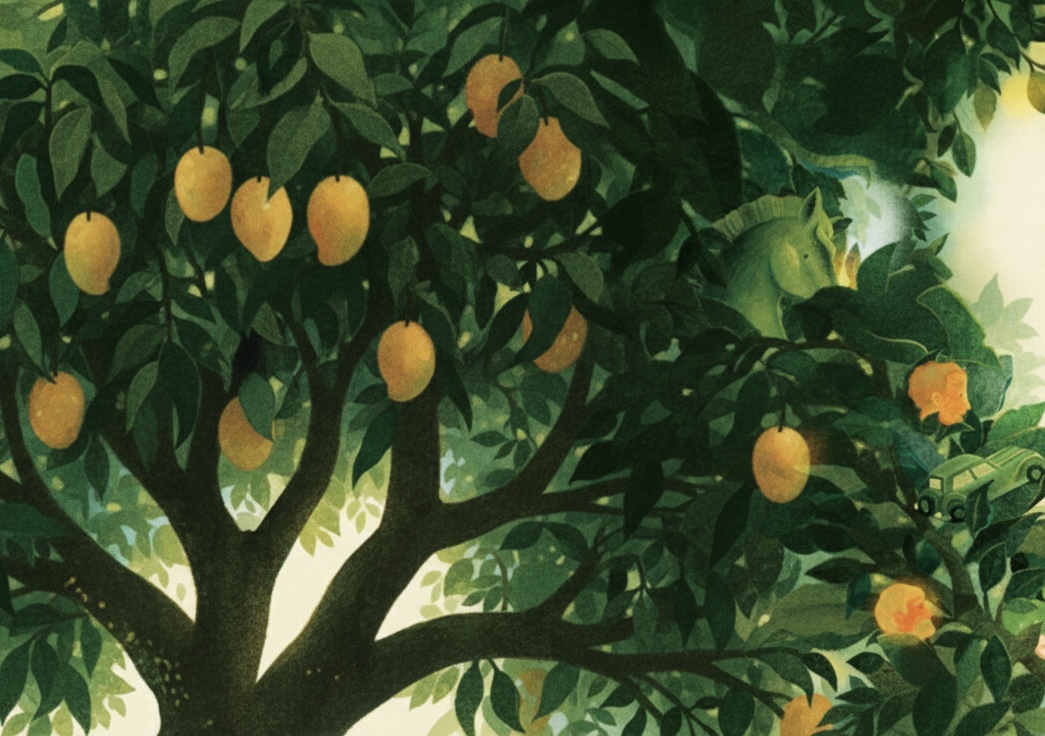
Illustration by Brian Nguyen
“You look just like him,” my Tita said as the bass of a jeering crowd from the Sunday night football game boomed behind her, echoing into the wooden-tiled corridor where I was sitting on the steps of the carpeted staircase. “Come here na. Let me see you.”
Rising awkwardly onto my shoeless feet, I started to notice just how small she looked under the haze of the yellow lights. After the summer of seventh grade and seemingly endless nights of growing pains, I had become tall enough that she had to crane her neck up ever so slightly to meet my gaze.
She cupped my face in her hands, gently inspecting my features by tilting my chin. “The nose. Eyes. Everything.”
“Really?” I flinched.
“Yes, all the same hon.” She paused vacantly right before she snickered and pinched at the baby fat on my cheek that I was overtly conscious of. “Very, very gwapo.”
I chuckled, watching as she winked and sauntered off towards the kitchen to check on the dessert in the oven that filled the house with the sweet scent of pineapple and brown sugar. Remembering now, I can still see that smile that stretched her red lipstick into a wide line when the words came from her mouth; a fleeting one that did not fully meet her eyes. I didn’t try to question it, then. During my teenage days, I tended to be too preoccupied with my own feelings ever to consider that the adults in the room had an entire world of hurt that they carried on their shoulders.
In the living room, with the out-of-tune piano and the parol star on the front window that flashed in bright green and red colours, signalling the winter season to come, I stared up at the picture frames on the walls. There were the same familiar faces that I have known my whole life. No pictures of relatives from the Philippines. No hint of our migration, but the colour of our skin in a different climate.
“Come on babe, kain tayo.”
A voice interrupted my thoughts, and I turned to see Mom behind me. She was still wearing her scrubs from her shift at the nursing home. Tired, but beaming at some joke that my dad made. She waved towards the dining room with a paper plate pinched between her fingers. The familiar, distant sing-song tune of Tagalog reverberated from the kitchen as the Titas and Titos congregated, and my cousins emerged from the basement, where they had been hiding, to play Halo or Guitar Hero. I nodded, following her to the table filled with home-made Filipino dishes and the same western staples we’d always make that indicated we were not in the homeland—kaldereta, sinigang, bangus, dinuguan, turkey, mac and cheese.
“Pray muna,” said one of the Titas, lightly pushing the rest of the kids around the table. A subtle ache began to stir in my chest. As usual, their eyes were all on me, hands folded, waiting for me to start. It was always the youngest one in the room who led the prayer. I picked the shortest one I knew.
“Blessed our Lord, for these thy gifts…” I noticed how my voice sounded twangy and high above the hum of the exhaust fan. The way it landed in all the ways I didn’t want it to. That summer’s growing pains were not only in my legs, but in my heart—sweltering nights spent trying to convince myself I didn’t have a crush on one of my Kuya’s friends. A hard pill to swallow that made my throat burn when I reached the end of my prayer and said “Amen.”
Later that night, on the car ride back home with full bellies and food still left over for tomorrow’s baon, I brought up the conversation I had with my Tita at the stairs. My dad’s eyes fixed on me from the rearview mirror, but nothing came from his mouth. He just kept driving, the passing streetlights illuminating his face in an orange glow.
Mom broke the silence. “Your Tito Libio. He was Dad’s Kuya. He was only sixteen.”
“Oh,” I murmured under my breath. In my head, I imagined him older like my Titos, who at this point, were sporting bald heads and grey hair. Not my Ate’s age. “How did he die?”
The car sped up in the sleepy streets of the suburb, casting shadows long and far against the concrete. Past midnight, it was only the workers returning from their long shifts or the bored teenagers looking for something to do or trouble to make when their parents weren’t home. “He was climbing a mango tree in the Philippines. They get very tall there. And when he was at the top….” The traffic light turned red, and dad pressed against the pedal, making the seatbelt tighten fast against my chest “…. he fell on his head. And he died.”
Nowadays, I think about how painful that must have been. I wonder if the grief still lingers between the pauses of words. If the aching followed my Tita all those decades ago on the plane across the Pacific. If she often thinks about whether he is here, or not there, buried in a homeland she only returns to when the flights are cheap or when another sibling dies. But I didn’t think of that at all, then. I was immature, insecure, and self-conscious. I didn’t know anything about myself or my origins. I just knew I had to feel sorry for my parents for the lives they lived and make up for it with mine. I resented it. I resented everything.
So, I laughed.
//
“Can I tell you something babe?”
I shook my head, smiling, and looked up at him from across the dining table. It seemed like he always started a story with a question; something I found both endearing because of how completely earnest he was, but also slightly annoying when I was too hungry to care. However, I appreciated how he always asked for permission, even when it wasn’t necessary.
“What’s up?” I asked, peeling the soft skin of the mango from its yellow insides and carefully cutting around the hard core with a knife.
“Well…did you know in the Philippine that people can just grab fruit and vegetables from anywhere. It’s so fresh. If my Lola wanted to make tinola, my cousins and I would go and pick the malunggay leaves growing at one of my neighbor’s fences.” My boyfriend smirked at the thought, his eyes softening as he layered the slices of mango onto the cream and graham crackers inside the plastic container, much like a lasagna, to make our mango float.
“Really?” I drawled out, focused on my busy hands. “I don’t think I’ve ever seen malunggay leaves here and these damn mangoes cost me twenty-five bucks for five at the market.” He clicked his tongue. “So expensive. I’ll put it in the app later so we can split the cost.” I bobbed my head in agreement, and a quiet passed over us as we subverted to the rhythm of slicing and stacking, the noisy traffic outside filling the dining room through the open windows. “Babe. Are there Filipino mangoes here?” I had just remembered seeing a Facebook marketplace ad selling them for a hefty price.
“Not really. The thing about Filipino mangoes is that they’re really, really sweet. Most of the ones here are imported from Mexico. It’s rare to see Filipino ones, and if we do, it’s expensive. Probably because of trade agreements or whatever.”
“Hm.” I paused, setting down the knife and mango in my palms and reflexively adjusting my glasses with the non-sticky part of my hand to meet his eyes. “Then, I don’t think I know what a Filipino mango tastes like.”
“What?” He snorted sharply and shook his head. “That’s crazy. We have to visit soon.”
“I agree.”
“We can visit during Sinulog in January. It’s this festival in Cebu that’s –”
“I know, I know.” I interrupted, driving the knife down into the mango hard. “You’ve told me this before.”
He furrowed his brows, shifting in his seat. “Okay.”
I swallowed, feeling my breath leave my lungs hard in my chest. My mood was changing fast, and the issue was I knew completely where it came from. “I’m sorry.”
“It’s fine.” He exhaled harshly, sympathetic, but deservingly quiet.
The room cascaded into a nothingness, and I remembered that first time cooking adobong baboy together in his old apartment, between kisses and slow dances. When it was time to eat, and he suggested we eat with our hands, he laughed at my clumsy and uncoordinated attempt. After teaching me the proper form, he said that’s how a “real Filipino” does it and something had just stirred in me, then. Something deep and unsettled. I cried, and he hugged me tightly, the voice of Nina Simone in the background lulling me to a soft surrender. I guess it made sense that the grief of losing a home I’ve never felt welcome in came out in the most domestic ways possible.
“So…” I cleared my throat, stumbling against my words. “We had that educational discussion on the realities of Filipino migration the other day and one of the kasamas was saying that fruit would literally rot in the farms because there’s so much, but the farmers are not allowed to sell them because of their landlords.”
“That’s true,” he deadpanned.
“I guess that’s why we say the Philippines is rich, but the people are poor.”
I peered up, but he wouldn’t look at me. It was warranted. A trend that I knew was becoming irritating to him by the second. It could be one single thing, and I was at the mercy of a deep numbness that took over my rationality. It was uncomfortable to recognize, but even harder to voice out loud.
“I’m sorry…” I took shallow breaths until the aching in my chest receded and some clarity passed over me. “Sometimes, when you repeat things that I already know about the Philippines, I feel…I’m not exactly sure how to explain it, but it’s this sense of inadequacy. Like I know I’m learning the language and re-learning things about what it means to be Filipino coming from a fucking white suburb, but I can’t help but feel shit about it! You know? Like how the hell am I just learning about who I am right now? Why didn’t my parents teach me? Why-”
I stopped, aware that if I continued, then there was nothing that could stop tears from flowing.
“Babe.” His face scrunched up, his tone direct and unwavering. “You are a real Filipino.”
I heard those words so many times since I knew him, but somehow, they still hadn’t settled within me. There was a difference between what I knew and what I felt. What was rationally and materially true, and the subjective fantasy that my mind had conjured up after twenty years of believing it wasn’t true.
He continued, offering a slight smile. “More than a lot of people. And more than all those fucking wealthy elites who sell out the country for more cash in their pockets.”
“I’m just having trouble feeling it.”
He sighed. “Coming from a Filipino born in the Philippines, you are Filipino not only because your parents are from there, but also, because you organize. Because you see the suffering of our people and you dare to fight for them, you know. Because you try.”
I blinked hard, feeling a swelling behind my nose. “Sometimes I just get these thoughts where I’m like—I wish we didn’t have to fight all the time. Like why the fuck am I here? In this stupid country where I don’t even know my own language.”
He suddenly rolled his eyes, grinning wide. “Okay burgis.”
“Hey! I’m just telling you how I feel!” I swatted at the air towards him jokingly, the sudden sarcasm jolting me into place.
“I understand. But hopelessness won’t solve anything. We’re all working towards something even bigger than ourselves, right? Bigger than the two of us. So, none of us are forced to migrate here and be exploited. So that pain you feel doesn’t have to happen to anyone again. So, we can stay in the Philippines. You have me. You have the kasamas now.”
“I know.”
“You know everything, huh?” He giggled, holding out his hands to me from across the table. “I believe that we will see a liberated Philippines in our lifetimes. Do you?”
“I think…” I intertwined my fingers with his, our hands still sticky from our creation. “I’m trying.”
He squeezed me firmly and quickly pinched my cheek. “That’s a start.”
“I guess,” I tongued out theatrically.
“Gago.” My boyfriend stood, yawning and stretching his arms above his head. “There’s a rally down at Joyce later today, are you coming?”
I smiled. “Of course.” I started gathering the dishes, stacking them into a big heap to carry to the sink.
“Let’s put this in the freezer. By the time we get back,it will be ready, and we can eat and share some with our neighbours. Wow!” He raised the finished mango float towards his face, pretending to bite it by clacking his teeth together.
I laughed and stepped towards him. I loved the sort of wonder he had in his eyes. The way he looked was just like his childhood photos in the Philippines.
I kissed him on the cheek softly. My boyfriend. My kasama.
“Thank you.”
//
On a FaceTime call with my parents, I am trying to relive the story of my Tito from my childhood. My mom’s face covers most of the screen as she squints at the camera, lying on the bed next to my dad in their lamp-lit room in my childhood home in Ontario, while the afternoon sun in Vancouver strobes like wildfire strongly through the window of my living room. The signs of aging are far more noticeable now, but as I reach the age of twenty-four, their demeanour has shifted. More understanding, more receptive, apologetic—something I never imagined would happen as a kid. “He was a genius,” Dad says. “Like you.”
They tell me that the mango tree Tito Libio died climbing was growing at his high school in Cagayan. That sixteen-year-old boy, at the top of his class with a bright future, scaled the heights of an unforgiving landscape, only to end up falling on his head. Apparently, he was so loved by his teachers that they personally delivered his body to the rest of the family, who were living in Cebu at the time.
When he died, Dad said that Mama lost her mind. Overwhelmed with the grief of losing a child, she slept in the cemetery for days, tending to the gravesite and talking to his ghost. Regrettably, I used to tell the story with a snicker. A way to get my friends laughing at lunch break. My tendency to be insensitive to the people I love is to get others to love me. “My uncle died climbing a mango tree!” I’d say. “Isn’t that stupid?
Now, I can only think about the descent.
How horrifying that must’ve felt to lose your grip. How he must’ve done this a million times before, but that day, he took a wrong branch or underestimated his strength and paid for it with dirt. Papa died in Cagayan, too, when I was in high school. He just walked into a store and fell, hitting his head. I’d see pictures of his funeral online. Mama died years later in the Philippines.
It’s strange. My parents talk about our motherland as if it were a graveyard. As if it no longer exists. As if those memories—the painful ones they only speak of in passing—could stay buried there without understanding that they are mine as well. That their lives are also mine. But my boyfriend talks about the archipelago like it’s a garden—a mango tree. History, like roots, sprouting out from the ground and reaching out to me, beckoning me to climb.
I think I understand now. How tenderly painful it must have been for them to watch a child grow up in front of their eyes and look just like the brother they lost at a young age. But also, how wonderful that I get to continue his life here. As I grow, and the sun pulls at my skin, and walking gets harder, they get to see him age through me.
My people will return. Not to visit, but to stay. I swear. Someday, we will go back to our homeland, and we will climb that mango tree. Hoist broken bodies up its hard bark. Scratch knees against its roughness as we ascend, straining and sweat beading down our backs. Feel the breeze and the rustling leaves as we reach its top and look out onto the Philippine countryside. The vast rice terraces, where farmers make their living, with no landlords, no foreign miners, and no chains. We will take the mango, peel it back like so many callused and overworked hands have done before, and savour every single bite of its flesh as it juices and drips from our mouths. For then, we will know just how sweet the fruit of our people’s labour tastes.
Adam Arca is a Filipino migrant rights organizer with Migrante BC and writer currently living and working on the unceded and occupied territory of the Musqueam, Squamish, and Tsleil-Waututh Nations (Vancouver, Canada). A son to migrant workers from Bulacan in Luzon and Cebu in Visayas, their work is deeply informed by care and the archipelagic connections between anti-colonial and anti-imperial struggles from Turtle Island to the Philippines. Their essays and poetry have been previously published in Briarpatch Magazine, The Funambulist, Plenitude Magazine, and Fatal Flaw Literary Magazine.
Brian Nguyen is a visual storyteller whose creative path has taken him from Hanoi to Busan to Vancouver. Recently joining Ricepaper Magazine as Visual Editor, Brian brings a fresh and dynamic perspective shaped by his cross-cultural journey. With a background in Professional Communication and a passion for photography, he believes his mission is to connect with people—visually and emotionally—through stories that uplift, encourage and humanize. For Brian, visual storytelling isn’t just about aesthetics, it’s about reaching people where they are and making them feel seen.