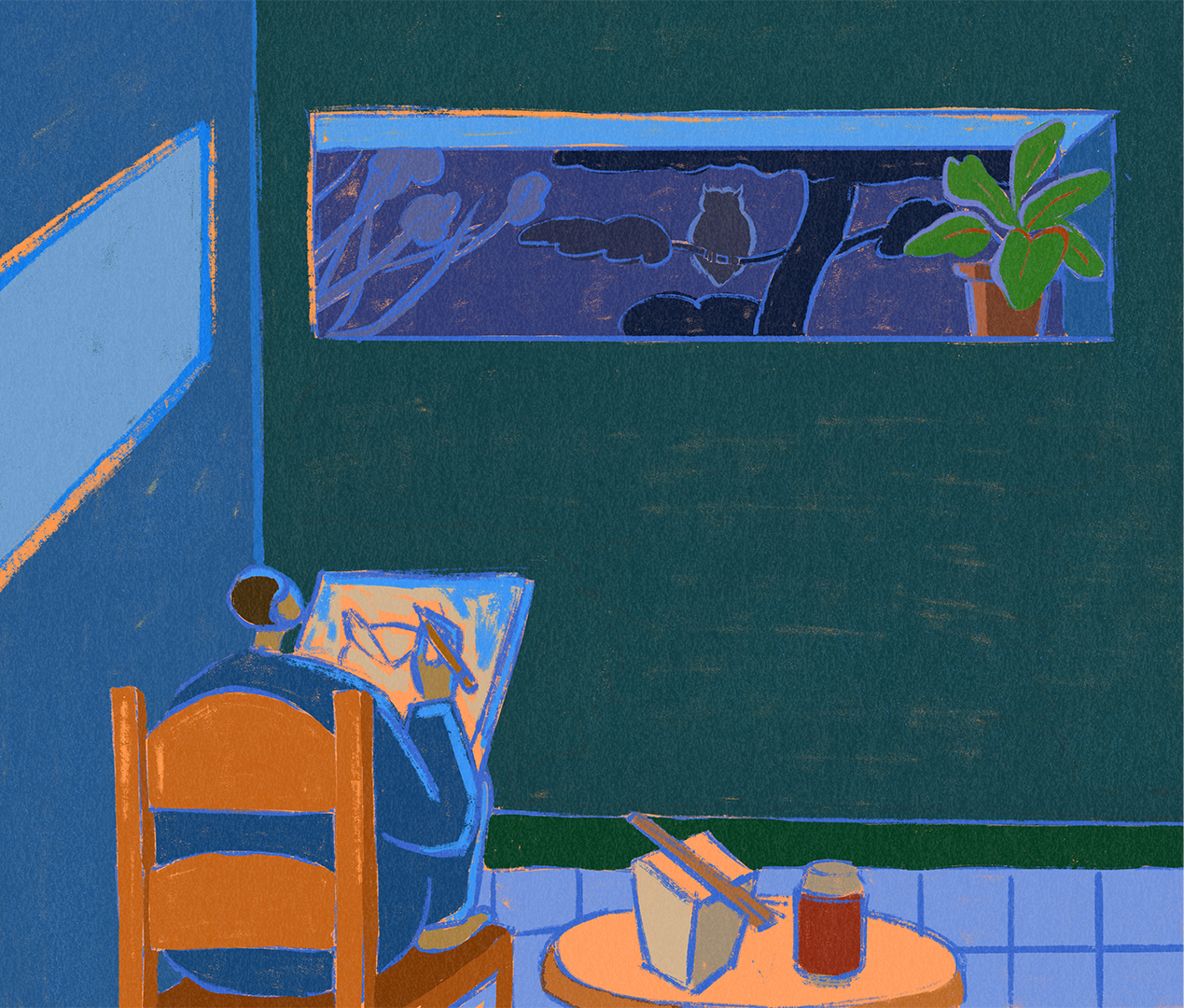
Illustration by Arty Guava
Another winter is flowing through my life here, in this freezing country. Back in Hanoi, winter tends to arrive with the suddenness of the northeast monsoon squalls: one muggy evening, then—flip—a winter morning, wind roaring, reaching into you as if robbing you of yesterday’s warmth. Here in Canada, it doesn’t come like that. It comes slowly, but the cold is unmistakable. It doesn’t steal anything. It crawls into every gap you didn’t seal shut, then bites your face, any skin you can’t hide.
One December evening I get into the car after the sun has fully set, though the clock reads only 17:00. In the city, snow is kneaded by tires into slush along both sides of the road. Once I cross the bridges over the Ottawa and Gatineau Rivers, my breath loosens; the forest takes us in, me and the car.
As I drive, my mind drifts to the PR-for-sale business that runs through fake marriages here. This morning, a Vietnamese coworker proposed that I enter a sham marriage and file sponsorship paperwork for a friend of a friend back in Vietnam. He said, “I’ll pay you eighty thousand Canadian dollars.”
Hearing that, I refused at once: “No!” Flat, without anger, without anything you could call emotion. My hands still submerged in the dishwater, my gaze swimming in it too.
This isn’t the first time I’ve heard of that “market.” Sometimes I imagine the community publishing it as an open letter to single citizens and single PR-holders: sell a few years of your life, help someone else immigrate, boost your finances.
Near the house where I live, the snow along both sides of the road is blindingly white: sometimes it runs into the winter-asleep fields, just as white; sometimes it runs into the forest, into the driveways of country homes, also white, but less so, because the owners blew the snow earlier today.
The Canadian winter countryside opens out before me, mesmerizing, yet my coworker’s voice slips into my mind: “Take your time. Change your ‘no’ to a ‘yes’ whenever you want. I’ll wait.”
“Up to you,” I said without looking up, unsure what expression I was supposed to wear. “Waiting is free capital, isn’t it?”
Here, we don’t fear the police the way we did in Vietnam. The law is clear: if you’re wrong, you pay. Even stories of illegal immigration and fraud, along with other little tricks and loopholes, circulate openly in the community. People learn what they can, and risk what they dare.
I know perfectly well that if I dealt directly with the person buying PR, I’d be paid CAD $100,000. CAD $80,000 means part of it has already fallen off along the way. Either his acquaintance skimmed it, or he slipped it into his own pocket. Numbers don’t shape-shift on their own, do they? I said “no” not because the price wasn’t market rate. I have my own reasons. Reasons that, spoken aloud, would only make me seem odder in the eyes of people like that coworker.
“Either way, you’re not exactly good at getting women, right? Sell a few years of bachelorhood. You get money and you get to use pretty girls. We’re close, I’m telling you honestly,” my coworker kept persuading me. And he didn’t stop at words; he thrust his phone screen almost into my eyes: a photo of a woman around thirty, lips painted a glaring red, wearing nothing but designer labels.
“No!” This time my “no” rang out louder than the clack of plates as I stacked them onto the shelf.
He didn’t need to strip me naked; the naked truth did it for him. My chronic loneliness, a loneliness I might carry for life. My body is scrawny, not my brain. I know that to fool immigration officers, if I signed a contract, the fake wife and I would have to perform being in love down to every intimate detail. Down to sex itself.
I say “no” not because I scorn money or fear being deported from Canada, but because I can’t accept playing at fake love when I want the real thing. The chance that my fake wife would also love me back, would change her mind and become my real wife, is close to zero. People with enough money to buy PR like that have pride so high they won’t lower themselves to stand beside someone as oddly short as me, so much money they can live far better than I can, and too little integrity to love and live for real. The last hope that would keep my odds from being zero.
My repeated “no” is no longer confined to my mind; it’s out of my mouth. I swerve into my driveway.
The room I rent is one of two basement rooms in a country house on the outskirts of both Ottawa and Gatineau. The two cities are either divided or stitched together by a single river, depending on how you choose to look at it. I choose the edge because it’s cheaper, and because I have never loved city life. A contradiction, I know: I reject its logic, yet I depend on its crowds. It gives me work.
Last night, more than twenty centimeters fell; the temperature dropped to minus 15 degrees Celsius. The snow is powdery now, not packed into slick ice. When you step, it squeaks. Squeak squeak, firm underfoot. I park in my spot on the driveway, wedged between the cars of the other two tenants. All three of us are immigrants: one from India, working for a moving company; one from Romania, a construction worker; and me, from Vietnam, still unsure what my profession is.
When I get home, I retreat straight into my room; I’ll eat dinner there too. The landlords have set up a small kitchen and a dining table downstairs for the tenants. Sometimes I cook and eat there, but most days I eat in my room, leftovers I bring back from the restaurant where I work.
After I lay the food out on the table, it’s already 19:30 p.m. The moon is full tonight, bright; I eat dinner under moonlight. Through the tiny basement window, only winter moonlight can slip in: it cuts a cold white strip across my small table, which is both my desk and my dining table. In places near the equator like Vietnam, the moon in any season climbs straight up from the eastern horizon and drops to the west. Not here: the northern winter moon only sweeps through an angle of about sixty degrees toward the south, as if an invisible string were tugging it back that way. I climb onto the only chair I own, trying to widen my view as much as I can.
Even so, my view is still blocked here and there by dried hydrangeas. In autumn their pale pink shifted to deep purple. Now the leaves are gone, thin trunks and branches exposed, and at the tips the hydrangea heads. Dry, too light to fall away. When the wind blows, the whole bush looks like a bundle of heads on bony necks, nodding yes, yes over their pitch-black shadows on the snow.
Beyond the hydrangeas, pines and spruces wear uneven patches of snow like camouflage coats to blend into the night and the ground. More numerous still are the maples. The wind has taken their red-orange-gold leaves; what remains, trunk and branch, looks no different from the broom my mother uses to sweep the ceiling, brandished at the endless air above.
Thinking of my mother and that broom, I remind myself, “Tomorrow, if you have time, remember to send your monthly money home.”
“You don’t need to send money to the family anymore. Hoi An is a tourist town now; I rent out the house your grandparents left behind. The family and I have more than enough to eat. You should think about your own future. You must marry a wife and have a son. Then I can die in peace. Your father’s entire Dinh line has only you left to carry it on…” My mother has someone write that text message for her, but I still send the money. I don’t want to owe her that milestone of peace, a milestone we both understand as a kind of inherited debt, one I have little hope of paying back.
Women pass by me the way they pass by a broom left standing in the yard, waiting for the floor to get dirty so it can sweep and not be loved. My body is small, small to the point of oddness; they treat me like a twelve-year-old boy who, for some inexplicable reason, already has a man’s stubble. They let me sit beside them, telling me things they would never tell other men. In the image of the broom, I feel the warmth of their hands gripping me, moving me, pliant, from here to there. That’s all. A person and a broom can’t create into children, can’t continue a bloodline. It can’t.
In truth, I do have a chance “to live” as something other than a broom, as a fake husband. That proposal keeps flirting with me. I even sketch out a plan to trap “my wife” into pregnancy.
But “no,” I persist.
No, I can’t rape a woman, even if she has signed a contract inviting me to do so. I’m not surprised by the scenario: a man’s body thrusting forward, and beneath him a woman’s body cold as a corpse, wanting nothing but for him to finish quickly. Those scenes are everywhere, on screen and in life; what chills me is that they can pop up inside my head as if they were mine. If it were real, I wouldn’t be able to go on living with that memory. I would die from the very idea of dying. And if everything is only to die, then what difference is there between dying with money or without it, in Canada or in Vietnam?
Admiring the landscape for a while, I notice an owl in the night, its feathers are impossible to make out against the back light. Here you usually see two kinds: white and gray owls. It stands almost motionless on a branch that juts out over the driveway.
When I draw, what I love most are details that don’t fit the whole, like that owl. It perches there utterly still while the wind moves around it, trees sway, and snow doesn’t fall from the sky so much as lift up from the branches still holding it, making the air sometimes hazy, sometimes crystalline. The owl is so out of place that I could take it for a durian fruit growing in the wrong country.
Right. How can I say I have no profession? I’ve finished my fourth year in the oil painting department at Hanoi University of Fine Arts. No, I didn’t graduate, but I began drawing long before those university years.
“So the karma is pressing down on you too, like it did on your father, my child!” my mother cried, half sobbing, half lamenting, when she saw me begin to pull out my father’s pencils and brushes and scratch away at paper.
My father had me when he was nearly sixty, and he died before I even learned to call out, “Dad!” He was a Vietnamese artist in the era when the Party and the Revolution decided that any intellectuals or artists influenced by the southern regime must be re-examined, must be sent to “re-education.” I don’t know what happened to him, or how it implicated my mother. But the way she looked at me and said that, it was as if all her resentment had been laid on my shoulders. I didn’t want to make her suffer more, but I couldn’t stop myself from rummaging through my father’s books and drawing tools: they lay in dusty trunks, in the altar room where we worship my great-grandparents, my paternal grandparents, my father, his first wife, and others I never met.
So the altar room became my private studio, except on the death anniversaries for one of the souls worshiped inside. People say my father’s ghost still frightens anyone who walks past. The ward cadre, also our neighbor, often reminds my mother to know her place, not to show dissatisfaction with the regime the way her husband did. Later, at school, classmates said my father secretly hanged himself from the jackfruit tree in front of the ward chairman’s house back then. Their “secret” is that he did it at night, when everyone was asleep.
The owl still perches in that one spot. As if daring it, I force myself to stand perfectly still too. Old Vietnamese people like my mother believe owls can communicate with the spirits of the dead. If an owl seeks your gaze, someone from the other side must be trying to send you a message.
“Could that owl be inhabited by my father’s soul?” I wonder.
When my half-sister offered to sponsor me to Canada, my mother agreed immediately. “Hien is the savior of this whole family. Surely your father’s spirit suggested she help you change your life!”
“Canadian law, other relative,” Hien said. “It lets me sponsor only one relative. Go, little brother.” Her eyes stayed on me; her head dipped once, a quiet yes, as if to confirm my own.
So when Hien chose to sponsor me, it wasn’t generosity in the abstract—it was her one precious doorway, used once.
One nod, and now I’m here, watching a winter moon through a basement window. At first I clicked into this new world like a fill-in-the-blank exercise in English class: paperwork ready, a job waiting at Hien’s nail salon. But my body rebelled against the salon’s acetone fumes, so Hien sent me to a Vietnamese restaurant she knew in Ottawa’s Chinatown.
Working as a helper at a Vietnamese restaurant means doing a thousand things around a bowl of phở and a plate of fried rice: cooking, carrying, washing dishes, wiping down, buying supplies. All those helper tasks will never add up to a profession, but they bring one practical benefit: my food costs drop sharply, and my mind doesn’t have to learn things I don’t want, like inventing nail designs.
In Canada, as soon as I started earning money, I took over from Hien in sending cash home. Back in the subsidy era, our whole extended family, my mother and I included, didn’t die of starvation because of Hien’s few hard-won dollars.
The owl remains there, frozen in the frozen night. Soon I’ll set aside time to draw it again. With the tree, its shadow falls across the roof of my car. Out here in the outskirts, the moon isn’t dulled by light pollution; it shines so hard it feels like sunlight, but through dark sunglasses.
The Romanian man’s parking spot is empty; he goes out to pubs, comes home late, and sings loudly every weekend. The Indian man and I don’t; we save that money to send back home. Another oddness: we’re both from “the East,” yet I never have visitors the way the Indian man does. That, at least, works in my favor. The landlords are kinder to me, even as they talk about wanting to get rid of the other two.
For me, all of it brushes against my life the way it does when I switch from a 2B pencil to a 4B, or to an H, while sketching. It doesn’t change the idea, the composition, the feeling, the way my hand lays down graphite. We live with my long-trained habit of silence, shut in together until we’re almost ghosts.
Christmas is coming. On the drive home, I can’t help noticing that house after house is already lit up, decorated for the biggest holiday of the year. For locals, it’s a season of family gathering; it’s close to what Tết is for Vietnamese people. At times like these, anyone who is lonely feels lonelier, as if the Christmas air suddenly turns into gas meant for cooking, meant for keeping you warm, available to anyone who wants to smother their loneliness.
Often, suicidal thoughts come to me too, but they don’t wear the face of Death. They wear the faces I want to have and can’t, faces I can never lift into expression.
It’s late. I’m not sleepy, but I have to sleep anyway; the owl has already flown off to find another perch. I burrow under my thick blanket. At first it’s cold. I have to wait for it to warm up before I can fall asleep.
While I wait, my eyes roam around the room. In the half-dark, my paintings blur, as if they’re painting themselves more perfectly. Ghostly. Four walls can hold only a small fraction of what I’ve painted, what I’m painting, what I’ve been trying to sell for ages, yet no gallery, no collector, has ever cared to look.
In that same ghostly way, sometimes I see my father’s body hanging among the paintings.
I’m not afraid of ghosts, least of all my father’s. He died before I had any memory. I have only one question for him: “If a painter hangs himself the way his paintings get exhibited, can his death become a painting too? And if it can, who would want to collect that kind of painting?”
That question is probably too complicated for an owl to translate for us, my father’s ghost and me. All the better; as long as I can’t hear the answer, I still have the chance to keep asking it. One and one, I ask it on diaspora winter nights.
A question like that has to exist; it has to be asked. The story behind it doesn’t need to chase an ending, doesn’t need twists or high drama; it only needs to make loneliness a little lighter for those who are lonely. When we’re surrounded by nothing but pockets of solitude, we long to hear the echo of that solitude.
Thuy Truong was born in 1969 in Hanoi, Vietnam. She is the author of Biển của vô cùng (Phuong Nam Books, 2012), and her English-language work has appeared in Montreal Serai and Danse Macabre Magazine.
8 comments
Tôi thích câu này: Cảnh sắc mùa đông Canada trải dài trước mắt tôi, thật mê hoặc…
hình ảnh mà tôi thích:
Ánh trăng mùa đông rọi qua ô cửa sổ nhỏ dưới tầng hầm, tạo một vệt sáng lạnh trên chiếc bàn nhỏ, bên ngoài là tuyết trắng yên lặng, xa xa có một con cú đậu bất động trên cành cây.
I like this sentence: The Canadian winter landscape stretches out before my eyes, it’s enchanting…
My favorite image:
Winter moonlight shines through the small basement window, creating a cold streak of light on the small table, outside the silent white snow, in the distance an owl perches motionless on a tree branch.
tôi thích nhất câu này: “Women pass by me the way they pass by a broom left standing in the yard, waiting for the floor to get dirty so it can sweep and not be loved”,
hình ảnh mà tôi thích:”The owl remains there, frozen in the frozen night.
Cả câu văn và hình ảnh trên đều miêu tả về cảm nhận của nhân vật trong câu chuyện rất cô đơn, Người kể tự nhìn mình như một công cụ, không phải một con người có khả năng được yêu.
Being separated from your homeland creates unexpected and fortuitous feelings. This short story duly captured those peculiar personal thoughts. Well written.
Excellent reading ! Very touching.
The beauty of the writing reaches our own inner solitude—and comforts it.
I love your writing style, which so beautifully captures an atmosphere, a state of mind. How does one adapt to another culture without abandoning one’s own? How does one avoid being frozen by the winter when coming from a tropical country? How does one live with solitude without losing one’s sense of humor and giving up the search for true love? A text that is both sensitive and informative. Thank you for sharing.
so touching….