Art by Leohoho
We walked close to each other to barricade against the wind that whipped hair over my face. His parents were about the only topic he avoided, and I was about to meet his father Jianjun, and his mother Phuong. Though he proclaimed to be an open person, he could never make eye contact when he talked about certain parts of his childhood, particularly his school days, and didn’t like to be probed.
“They sleep in separate bedrooms, but they keep each other company every Christmas. Those are actually my mom’s words. But they do their best — I’m sure you feel the same way with yours,” he’d say.
Am I only with him to not spend Christmas alone? I wasn’t sure. The streetlamps glowed faintly, the cold so biting we couldn’t focus on much else but balancing through the unevenly shovelled snow. In silence, we trekked to the restaurant at the corner, letting another couple pass through before pausing at the entrance.
“Have you been here before?” Lin opened the door for me, then let it slap against the purple-bruised sky.
“All the time! Especially when I first got to Toronto.”
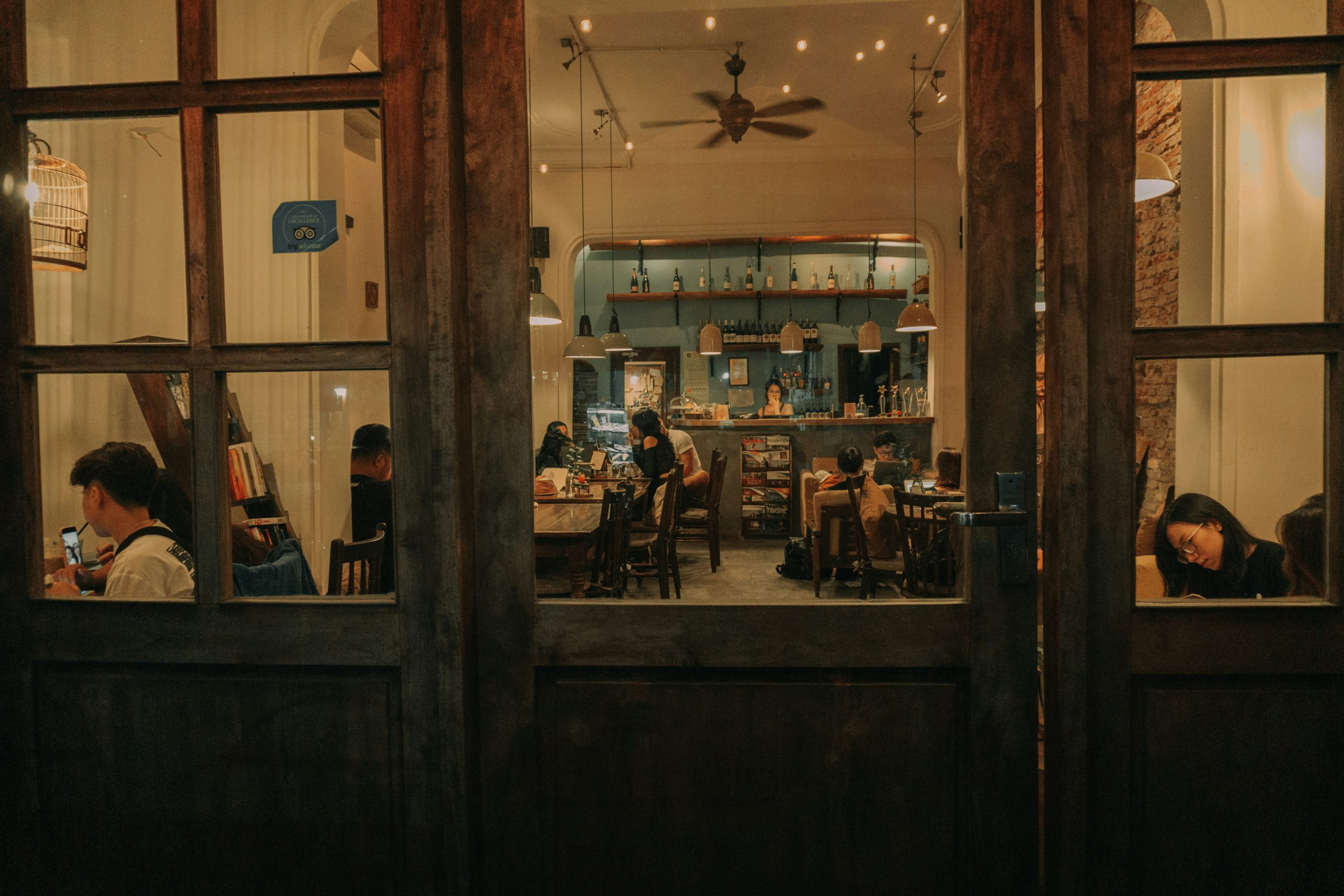
Tail End was a restaurant that stayed busy with Vietnamese locals. However, that night only two other tables were filled that evening — middle-aged men who lifted cigarettes from their lips while their chopsticks lay idle in broth-filled bowls. The only waitress who seemed to be working that night retrieved a notebook from her apron and stopped at our table.
Lin spoke first. “My parents drink green.”
“Fine by me.” I wanted oolong.
“But you just said you wanted oolong.”
I turned the menu to its back, inspecting the restaurant’s logo. “I also said it makes no difference.”
“Make up your mind, please.” He fixed his slick black hair before offering a smile at the waitress as if I had been inconveniencing her. She patted the table and said she would be right back. I could tell she was the ambitious type. Her hair was wound into girlish pigtails and she would later ask about weekend plans.
I saw something else shine under his eyes then — a startling flash, a whole new world of thought. I never really knew what he was really thinking, but I learned to believe what he vocalized, which was a lot. I chose to believe we had an equal wealth of information; I just kept mine for myself.
“Remember, it is good manners if you pour their cups before your own.”
I said that I know this.
“I don’t mean to be condescending Mai, I just want you to make a good impression. They will love you once they know you.”
He once described me as opaque, a word choice which reflected his bookish education and reminded me of the streets of BC where we grew up, vast mountains cloaking our town. Nonetheless, they will love you. Chosen family was a very western concept. You don’t choose, you adapt and live with what you get. That was my experience.
When the bell chimes again, I know it is his parents. His mother had a pixie cut styled high on her head, her fish-shaped eyes highlighted with charcoal black eyeliner. His father’s pointed jaw and tight-lipped purse matched Lin’s stoic description.
They are quickly greeted by the waitress, who unstacks four porcelain cups and places down the teapot, which I swiftly pick up to distribute in each cup. We are like well-oiled machinery. I slid it to his parents first. They seemed to enjoy the gesture, and began to pelter me with questions about myself, cushioned with small talk about the changes in the neighbourhood, assessing my opinions while keeping a poker face.
“Lin tells us you also came from British Columbia?”
“Yes, I did.” Everyone was silent so I took it as my cue to continue.
I watched as their eyebrows raised at certain anecdotes, smiling genuinely at the story of how we met. I met him sitting at a bar alone, poised with reassurance in having company. Two of my friends had gone off to dance with other men — shortages of men, boozed-up and hawkeyed, are never issues that come up on nights out. Lin showed up and called attention to the fact that I was sitting alone, which I had thought was some innuendo with which to insert himself — identify an issue that needs remedying.
It wasn’t until that realization of our similarities — we both came from Vietnam to British Columbia, then Toronto — that I decided we would be a good match. For that reason, I decided to suppress my inclination to draw into my own company, and went out with him the next day. On equal footing, both chosen and choosing.
When I introduced my parents and their occupations, they became much more curious, pausing their meal to listen intently with their eyes.
“Are your parents also in Toronto, Mai?” Phuong asked.
“No no, they’re still living in BC with my sister.”
“She came here herself.” Lin swathed his arm around me. “A self-starter.” He planted a wet kiss on my cheek. “And she got her first job straight away!”
I had not mentioned my first job: a wire factory on Geary, where I was let go shortly after I had severed my index finger on a stripping machine.
“And your parents?” His mother continued, ignoring her husband who subtly tried to catch her attention to pass a napkin.
“They’re both working in factories.” I left it at that.
“Without education, you can’t do much else here,” Jianjun asserted. “Are you in school right now?”
Lin was right about one thing — Jianjun was unrelenting. It was no wonder Lin was in law school and read up on every newspaper he could find. Even if he had no genuine interest.
“Don’t look now,” Lin suddenly started. He had a glint in his eye which suggested he had
barely been listening.
Grateful for the interruption, I twisted myself clockwise pretending to look for something in my purse, and followed his gaze. The other group of men looked at each other solemnly, pointing their teapot at a table across from them.
“Do you know what they’re doing?” he whispered into his cup, pretending to drink from it. “When one gang turns their teapot to the other, they are announcing a gang war. When the other group turns theirs back — they’re reciprocating.”
One of them began to move the teapot in but did not pick it up to pour — he only turned it slightly in the first group’s direction. Phuong had turned a little pale and put down her spoon. She was quick to believe.
We all became painstakingly aware of the situation, the four of us, and that tension-soaked exchange, with its underlying gift of bondage between the four of us, had made me forget about the commonplace conversation earlier. I took the pause to gulp down some broth from my bowl — it had cooled as I had done most of the speaking.
It was Lin who made the first big move. He stretched out his arms, languid, and with his flexed shoulders and chest drawn out, he swiped at the table, sending a spoon flying over by the closer group’s table. The tension ripped, my fingers plummeted ice-cold. Lin did not move, as if waiting for one of the men sitting at the table to lean down and pick it up for him. The man closest to the spoon with spiky black hair glanced at the spoon and turned at our table. He proceeded with his dinner. I exhaled.
“Lin,” Jianjun huffed, “You take too many risks sometimes.”
Lin smiled, bearing most of his teeth. He was vulnerable with me only after rehearsing with another. I knew this and would try to pass it off as trust, but it was only an echoed form of the real thing. For him, to truly be caught off guard was rare and unpredictable. There is no risk in that. And more, how could he ever truly see me when he was busy keeping his veil unpierced?
I wanted him to see me for what I was capable of seeing through, how bold I could be. There he sat, with his puffed out chest and assured smile, already reaching for his wallet as the waitress strolled out of the kitchen, eyes searching for something to do.
So I talked about my time in BC. My family needed the money, so when a job agent contacted my parents to start a growing operation in our rented house, they agreed. That, I say, is the reason I left BC — to start over, for myself.
Lin’s parents’ eyes offered soft understanding, but Lin was caught by surprise. He watched me curiously, an ear turned up like a dog.
“Hou dak jan geng!” Phuong shivered. Lin reached to refill our cups with more tea, patting her on the shoulder.
“I can’t imagine what higher operations they were paying for,” he said softly.
When the dinner had finally reached its end, the waitress brought us takeout containers for our half-eaten food and jovially asked what we plan on doing over the weekend, placing the bill on the table.
Lin had gone to the bathroom, and Jianjun grew impatient, heading out for a smoke. When Lin returned, wiping his hands on his trousers, the man sitting by the spoon picks it up and hands it to him. Wordlessly with his head bowed, Lin took it and rushed it to the waitress like he was holding hot coal. Phuong grabbed hold of one of my hands.
“Now, I hope to see you during Christmas if you are not going back to BC?”
I nod, looking into her fish-shaped eyes.
“Don’t worry. Hou dou ni di.” Many such cases — they are meant to be words of comfort. I squeeze her hand back.
I will never reveal that the final story was not true. I had in fact known a family who used their house as a grow-op in BC, and my family had in fact been contacted by job agents hopeful to rope them in as well. But they never accepted the offer.
I grabbed the leftovers suffocated in plastic bags with a yellow smiley face, and followed Lin’s family left the restaurant.
Julie Lam is a writer based in Toronto, and an editor for the Spadina Literary Review.