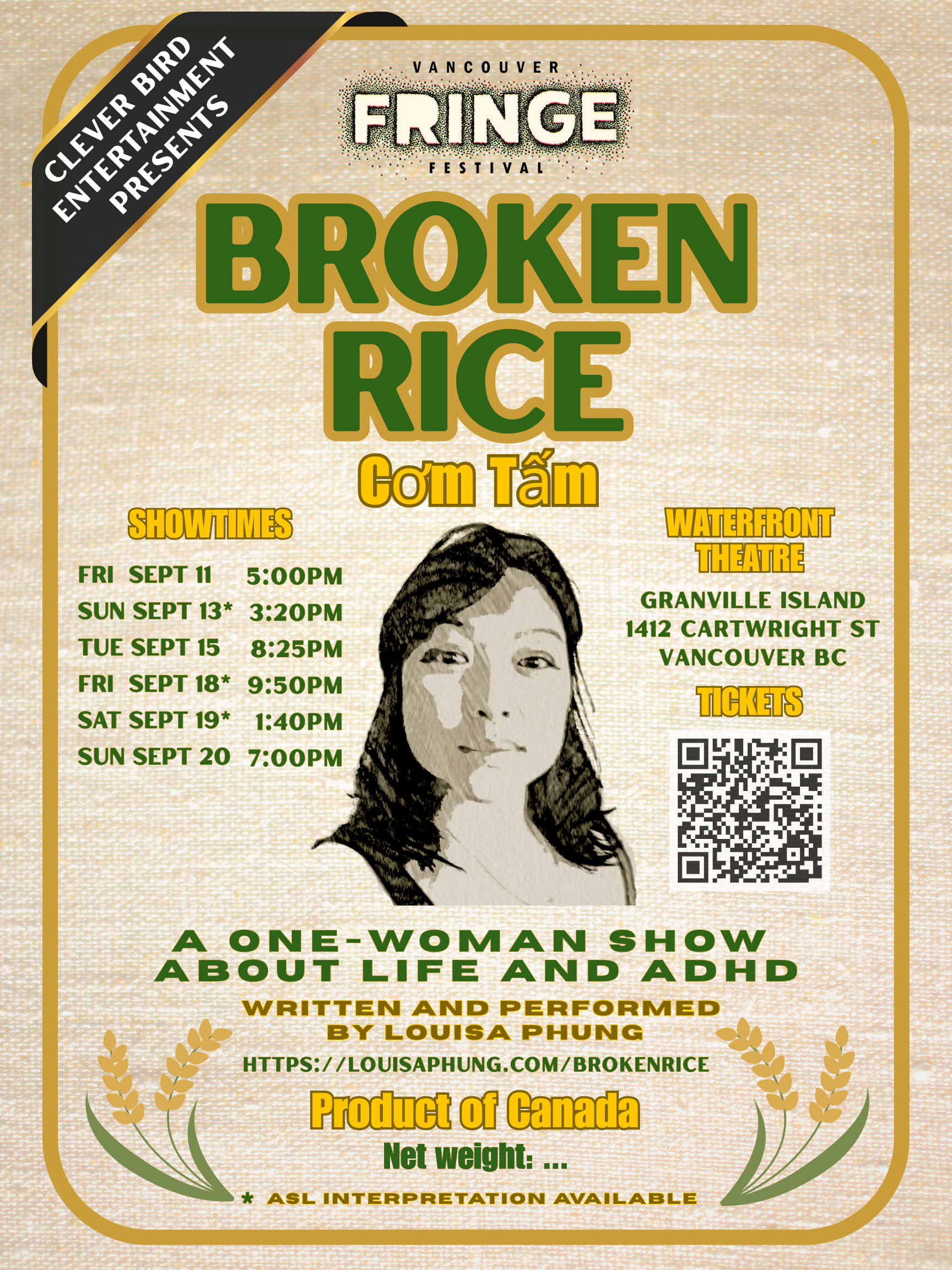
 Broken Rice: What thoughts does this title evoke for you? For me, the word “broken” stands out; it’s the past participle of “break,” meaning to tear or split into pieces. Broken is also a feeling: to feel broken, down and out, damaged, destroyed, and shattered are just some of the words that come to mind for me.
Broken Rice is the aptly named title of this play about Michelle, a Vietnamese woman in her 40s who is processing her recent diagnosis of ADHD (“Attention Deficit Hyperactivity Disorder”).
Broken Rice is also the name of a famous Southern Vietnamese comfort dish, Cơm tấm, made from fractured rice grains and served with savoury grilled meats, pickled vegetables and a sweet fish sauce.
Is Michelle broken because she has been diagnosed with ADHD? She questions her life in light of her diagnosis. She struggles to complete tasks, be on time, and maintain structure in her life, despite working hard to set timelines. Struggling to succeed and failing when she didn’t know she had ADHD must have made it so much harder. I believe Michelle was never broken before getting her ADHD diagnosis; she just felt broken, she wasn’t like everyone else. Getting the diagnosis was the validation that she wasn’t broken; she just had ADHD.
The play is set the day prior to the deadline for a major grant application. Michelle struggles to write her artistic statement. She questions who she is, what she wants to say, when she isn’t distracted by an item in her bedroom- a squirrel!
This one-woman play has heart. Not an easy feat to be the centre of attention, the one to entertain and keep your audience engaged, but Louisa Phung, in the role of Michelle, does it skilfully. Social media and the images and videos projected above the set add to the thoughts in Michelle’s head. Many clever aspects to this play make it a joy to watch.
She speaks to us on important and relevant topics: mental health (shame, guilt, you name it, growing up Asian isn’t for the weak of heart), Eating Disorders/Body Image, being Asian, and being female. Worst of all, the “Asian shame” of being in her 40s and, ugh, unmarried and without children. Choosing a career as an artist wasn’t widely accepted or understood by Asian parents, although I like to believe that over the past 10 to 15 years, it’s become much more accepted because of the many mainstream successes of Asian artists.
The play references The Bamboo Ceiling.
“When I walked into the boardroom, scanned the faces at the table, and felt it in my bones — no one there looked like me. Not in this meeting, not in the C-suite, not in the glossy leadership brochures. I am a Chinese Canadian woman with decades of experience, yet my reflection is missing from the highest ranks of leadership.
This is not just my story. It’s a pattern, confirmed by data and lived by countless others. And it’s time to name it for what it is: systematic discrimination, sustained by silence and the comfort of the status quo.
The Bamboo Ceiling
Despite being overrepresented in white-collar jobs, Chinese and East Asian Canadians are severely underrepresented in executive leadership positions. This phenomenon, known as the “bamboo ceiling”, is not simply about a lack of qualifications. In fact, Chinese Canadians are among the most highly educated groups in the country, with 56.39% of all bachelor’s degree holders aged 25 to 64 identifying as Chinese, compared to only 32.96% of the population in that age group, per Statistics Canada in 2021…” Janice Mah, published May 1, 2025, LinkedIn
You may have heard the story: a teenager comes home, proud of the A they earned on an assignment. Running home to show Mom or Dad, only to get a response of “Why not an A+?”
Michelle struggles with intense doubt about whether she is worthy. In the end, despite now adding an ADHD diagnosis to her life, she discovers that she is a human being, just trying to take one step at a time to live the life she wants to have.
A diagnosis of ADHD in adulthood is something I have heard of several times in the past few years. A parent is diagnosed with ADHD along with their child. When the person was a child, a teacher may have suspected ADHD, but for one reason or another, the parent did not seek help for the child. The child struggles throughout life, only to get a diagnosis in adulthood.
Broken Rice is a brilliant play that deserves a wider audience. This play shines a light on adult ADHD.
The play runs for 1 hour with no intermission. Broken Rice is part of this year’s Fringe Festival and runs until September 20, 2026, at the Waterfront Theatre on Granville Island in Vancouver, BC.
Tickets will be available as of August 4th https://www.vancouverfringe.com/events/broken-rice/
Louisa Phung Suk Yee is a neurodivergent director and writer for both stage and screen. Born in Toronto, Ontario, Canada, she graduated with a Bachelor of Performing Arts Degree and a Diploma in Theatre from Capilano University, which sits on the stolen lands of the Coast Salish Peoples, including the territories of the xʷməθkwəy̓əm (Musqueam), Skwxwú7mesh (Squamish), and Səl̓ílwətaʔ/Selilwitulh (Tsleil-Waututh) Nations. She is based in Vancouver, BC. Louisa Phung (She/They) — Louisa Phung Suk Yee
Cynda Yeasting is the eldest of a family of five, born in Vancouver, British Columbia, Canada, to a Pioneer Chinese family. She is a third-generation Vancouverite. She has been a part of the Asian Canadian Writers Workshop since 2016 and a board member since 2025. She is the author of the memoir “For Michael, Love Cynda.” Now retired after being a Legal Assistant for 31 years, the arts, travel, teaching Zumbini, fitness, family (grandkids) and friends are what makes her heart happiest.