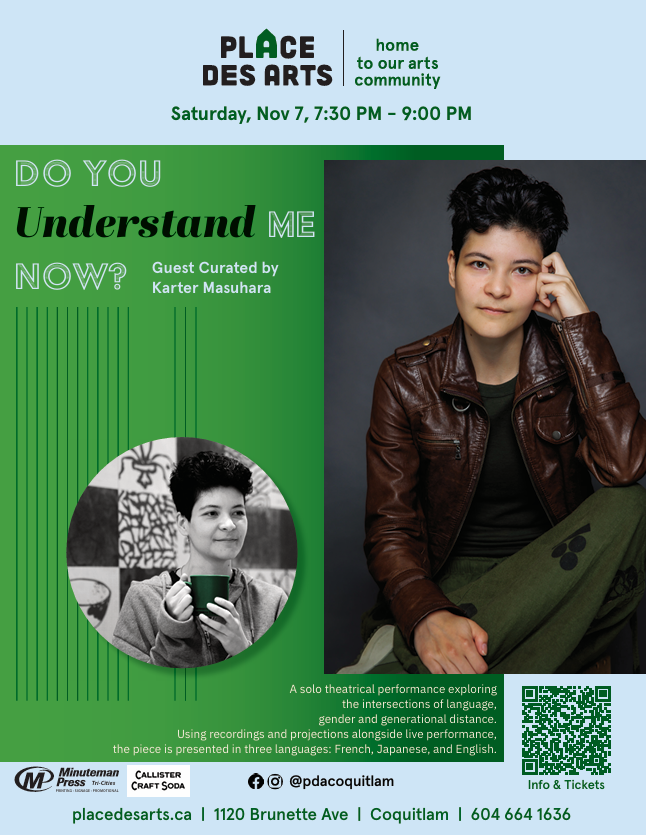
 Being Your Authentic Self
Do you understand me now? This question has more than one meaning.
Do you understand me due to a language barrier, or do you understand who I am, and in this case, your granddaughter who goes by the name Karter and is a trans/non-binary person?
First, how does Karter share who they are, and how do they explain their gender to an older generation, especially when language is a barrier to understanding? Even without language, helping someone from an older generation understand gender is generally a challenge. They may never be able to fully understand that Karter’s gender is not a choice, but who Karter was at birth.
In the play, Karter Masuhara adeptly switches between French, Japanese and English. The voices, along with the respective languages, change in tone as they portray their French maternal grandmother or their Japanese paternal grandmother. They use the ritual of drinking tea together to talk. The conversations are challenging because of language barriers and the expectation of who Karter should be, while they struggle to be their authentic selves. The frustration comes from trying to explain themselves while wanting to be understood and accepted, but also feeling frustrated by language and generational barriers.
This play is even more compelling because grammar has genders, and Karter wants their grandmothers to understand theirs.
Their maternal grandmother’s mother tongue is French. In French, every noun has a grammatical gender. This impacts articles, adjectives and pronouns. Generally, you would learn each noun with its article.
As well, there is no single set rule for all nouns; many female nouns end in -tion, -sion, -ité, -té, -ance, -ence, -ette, -aison, -ie
Examples: la maison (house), la liberté (freedom)
Many male nouns end in -age, -ment, -eau, -isme, -eur
Examples: le pays (country), le bateau (boat)
And to complicate matters, some nouns have both a masculine and a feminine version of the same word: danseur (masculine) or danseuse (feminine).
I know that in Spanish, all nouns are either masculine or feminine.
Language is a peculiar thing. So many nuances. Words and phrases used vary depending on your relationship to the person, at least in French, which I took until Grade 12. It was enough for me to survive solo in Paris for a few days, but I definitely don’t have command of any language other than English.
The Mandarin Chinese language has four main tones:
First tone (high-level);
Second tone (rising);
Third tone (low/dipping);
and fourth tone (falling); each tone has a distinct pitch. When the tone is changed, the meaning of the word changes entirely.
So, based on how you pronounce a word, it can mean something different. The word for mother, “mā,” is pronounced with a first tone, but the word for horse, the same character, is pronounced with the third tone, “mǎ.” Depending on the tone you use, you could be speaking about your horse when you mean your mother or vice versa.
- mā (first tone) – mother
- má (second tone) – hemp, numb
- mǎ (third tone) – horse
- mà (fourth tone) – to scold
Karter’s struggle to be understood is one that many can relate to, as each generation has different experiences, belief systems and communication styles. We can be unintentionally biased based on learned behaviour from childhood.
I have seen a few other one-person plays, and it is a huge undertaking to be the only performer, but I also believe this piece wouldn’t have had the same impact if others had acted out each role. The impact on the audience is much richer when one performer carries the story, at least in this case.
This was Karter’s first performance, and what a brilliant performance it was. Choosing to be so vulnerable and honest was brave, and it deeply touched the audience.
In the end, my takeaway is that Karter knows that both grandmothers love them, but love does not equal acceptance.
I hope this guest-curated piece becomes a play and is seen by audiences everywhere, especially youth.
The play ran for 1 hour with no intermission. Do You Understand Me Now was guest-curated at Place des Arts in Coquitlam, BC, on Saturday, November 7, 2026.
Karter Masuhara (they/them) is a trans/non-binary artist, producer, and arts manager based in Burnaby on the occupied xʷməθkʷə ̓yəm (Musqueam), Sḵwx̱ wú7mesh (Squamish), səlil̓ wətaʔɬ (Tsleil-Waututh), and kʷikʷəƛ̓ əm (Kwikwetlem) territories. As an artist they have written and directed an award-winning short film, Where to Piss, and self-produced their own play, Before They Cut Down Our Tree, which was presented at the 2023 Vancouver Fringe Festival. Do You Understand Me Now? Guest Curated by Karter Masuhara – Place des Arts
This piece was made in collaboration with Amélia Simmard, Davey Samuel Calderon and June Fukumura.
Cynda Yeasting (she/her) is the eldest of a family of five, born in Vancouver, British Columbia, Canada, to a Pioneer Chinese family. She is a third-generation Vancouverite. She has been a part of the Asian Canadian Writers Workshop since 2016 and a board member since 2025. She is the author of “For Michael, Love Cynda”, a memoir. Now retired after being a Legal Assistant for 31 years, the arts, travel, teaching Zumbini, fitness, family (grandkids) and friends are what makes her heart happiest.