Sean Gunn was born in Vernon, BC, in August 1948 and wants you to know that he is the son of a Chinese head tax payer, grandson of a railway worker, and great-grandson of a gold prospector. Jang Won Jeong (1831-1907; known as On Lee) was his maternal great-grandfather, a prominent member of the Chinese community in Yale, BC. From a childhood in Vernon to Vancouver, Sean’s time at UBC in the late 60s and early 70s was the heart of the Asian Canadian movement as Chinese and Japanese Canadians explored Asian history and identity together. To mark the 50th anniversary of the Asian Canadian Writers Workshop (ACWW), Sean shared a few personal highlights of the people and community connections that helped shape ACWW.
Effie: You had your 77th birthday in August, and ACWW celebrates 50 years in 2025. What was your role at the beginning of what we now know as the Asian Canadian Writers Workshop (ACWW)?
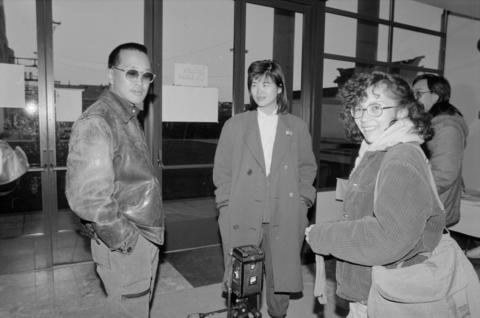
Sean Gunn with friends at the Chinese Cultural Centre after the Saltwater City exhibit reading. (City of Vancouver Archives)
Sean: I remember calling the first meeting, which was at 313 East Pender Street. It was the Chinese Cultural Centre office, but most of the early meetings were in our homes. We’d meet when someone had a poem or story they were working on, which they’d share and get critiques. We called it the Chinese Canadian Writers Workshop then. We published two issues of Gum San Po (1974), and I wrote a satirical tour guide called “Lofantown”. Members went on to create Pender Guy on Co-op Radio (1976-1981).
At that point, I couldn’t have imagined talking about ACWW 50 years later. Also glad I’m still here! Probably 20 or so people were involved. Music and politics were going on at the same time.
The Powell Street Revue was the equivalent for the Japanese Canadian community. We came together to publish Inalienable Rice: A Chinese and Japanese Canadian Anthology (1979), which included a couple of my poems. It was edited by Garrick Chu, Paul Yee, Ken Shakazi, Rick Shiomi, Linda Uyehara Hoffmann, and me.”
A few people who contributed a lot to ACWW have since passed away. They include Garrick Chu (1950-1979), who was a photographer, editor, and a good friend. It was a shock of a lifetime when he passed away suddenly. I had just seen him the night before at my sister Sharon’s wedding.
Of course, Jim Wong-Chu (1949-2017) was the driving force, and his wife Marlene Enns became the first treasurer and longest serving board member. She was on the first board and is still doing a lot for ACWW. When Allan Cho (Executive Director) joined, I felt good about the future of the organization. I met Todd Wong doing music, actually, but Todd has also been involved with ACWW for a long time and is the current president.
Ronald Tanaka (1944–2007) was my UBC professor and mentor to many of us from the Chinese and Japanese communities, including Jim, Garrick, Mayu Takasaki, Connie Kadota, Glen Nagano, and many more. It was the first time many of us were hanging out with other Asian Canadians. Both the Asian American and Civil Rights movements influenced us.
Ron gave photography workshops, inspired a lot of us to write poetry, and learn photography and start photographing our communities, including Jim. Chinese and Japanese Canadians were in informal groups called Gao Hing (“brotherhood”) and the Wakayama Group (many Japanese Canadians came from the Wakayama Prefecture), but we became known as the Asian Canadian Coalition. A major event was the Asian Canadian Experience photo exhibit at UBC, which Ron organized.
Ron was a Japanese-American poet and editor. Thanks to Ron, I had a poem published in 1970 in Gidra (1969-1974), a significant newsletter of the Asian American movement. Ron introduced us to Roots: An Asian American Reader (1971), the first Asian American anthology, and A Grain of Sand: Music for the Struggle by Asians in America, the first Asian American music recording (Charlie Chin, Chris Iijima, and Nobuko JoAnne Miyamoto). I also began listening to jazz, which Ron called “real music.” He once bought a Selmer saxophone and gave it away to a Black musician, and that story always touched me.
Effie: What else do you remember about ACWW in the early years?
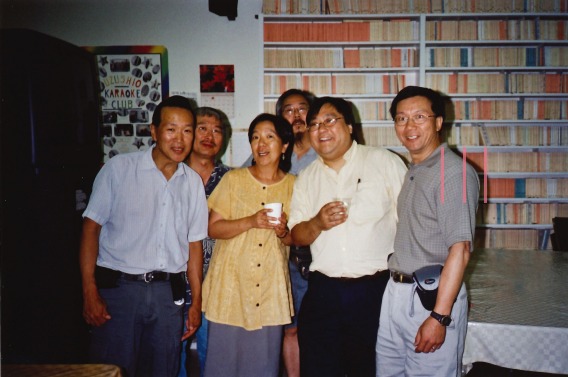
Sean Gunn, Jim Wong-Chu, Mayumi Takasaki, Sid Tan, Terry Watada, Robert Yip, at Tonari Gumi, circa 2003. (ACWW Archives)
Sean: ACWW has grown way beyond what we could have imagined. When we decided to have officers, Jim was elected as the first president. I was involved in community politics, but I tried to avoid being president or holding an officer position. I was a board member for many years, but also engaged in Chinatown politics and Asian Canadian music.
Paul Yee was a founder and a chief architect of the organization and was on the board for many years. SKY Lee had one of the first pieces we workshopped at her place. Meaning people would bring something to read, and we’d provide feedback. This piece ended up in Inalienable Rice. ACWW was more organic before it became more structured as a non-profit society.
Ada Con (1950-2024) was a board member for many years and did a lot of volunteering. She co-founded the Asian Literature Circle in 1994, and it is still meeting regularly.
Sid Chow Tan (Sidney Ming Fai Chow Tan; 1949-2022) was a past president and known more for the Head Tax Redress movement. He was a very good friend and got us to register as a non-profit. Sid was a community media producer and had a cable show called Chinatown Tonight. I performed music and was interviewed on the show a few times. When Sid passed away in 2022, I wrote a poem (“Sid Chow Tan”) that was published in the Heart of the City Festival program. We were friends for 38 years.
Larry Wong (1938-2023) was a community historian, board director, and wrote Dimsum Stories: A Chinatown Childhood (2012), which Jim had encouraged; Alden Escobido Habicon (1974-2024) was a past editor of Ricepaper; and Goh Poh Seng was a board director, writer of many books, and also a family doctor.
Effie: Community building among Chinese and Japanese Canadians played a significant role in shaping ACWW. Could you reflect on this aspect of ACWW’s history?
Sean: As I mentioned, Gao Hing and the Wakayama Group at UBC became the Asian Canadian Coalition. There was a very important Asian Canadian Experience Conference in Toronto in 1972, and some of us from Vancouver attended. This included my younger sister, Shannon Gunn (1956-2020), who performed on Arts Night with Joyce Chong. Shannon later became a jazz vocalist and composer. Joyce was one of the conference organizers and became a founding member of Kokuho Rose Prohibited and Katari Taiko.
In Toronto, I met Japanese Canadian musicians like Terry Watada and Martin Kobayakawa. I was inspired when I heard Terry perform his song New Denver, which was about his parents’ internment. The conference was like a shot in the arm and a lot of energy. Our experiences were very similar, especially for the third generation in Canada.
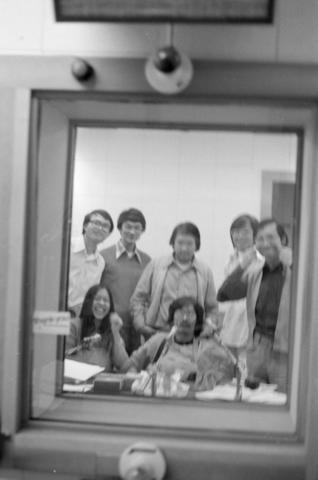
Tung Chan, Paul Yee, Sean Gunn, Dominic, Tommy Tao, Nancy Wong, Jim Wong-Chu taping at Vancouver Co-op Radio (City of Vancouver Archives)
I also wanted to write music about the Chinese Canadian experience. I’d write about the railway or political events, and music could be less personal, whereas poetry was very personal. Barry Wong asked me on the Pender Guy radio program if there’s such a thing as Asian Canadian music. I said it will exist because I’ll write lyrics about the Chinese Canadian experience.
I was in an Asian Canadian folk rock band called Number One Son with the Kuan and Kai Foo brothers, Martin Kobayakawa, and Terry Watada. We were the first Asian Canadian folk rock band to write lyrics that talked about the Asian Canadian experience. Kuan Foo was also the first editor of Ricepaper and a board director.
Effie: Can you share your memories of Powell Street Festival, which is celebrating its 50th anniversary in 2026?
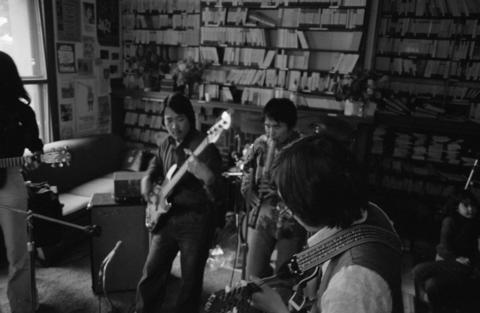
Kokuho Rose Prohibited performing during a marathon weekend at Vancouver Co-op Radio
(City of Vancouver Archives)
Sean: The Kokuho Rose Prohibited band played at the first Powell Street Festival, and I joined a year later. I played electric bass and did some vocals. For the 30th anniversary, we performed two shows with Kokuho Rose Prohibited, which included John Endo Greenaway (The Bulletin editor), Linda Uehara Hoffman, Rick Shiomi, Tamio Wakayama, Takeo Yamashiro, and Joyce Chong. The band had a cameo in the film Between Pictures: The Lens of Tamio Wakayama (2024) about Tamio Wakayama (1941-2018) by Cindy Mochizuki.
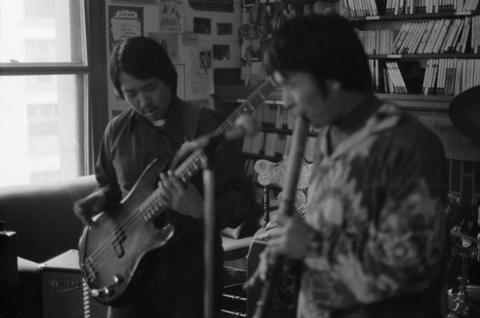
I’ve been going to the festival every year and had volunteered for 35 years. The taiko group from San Jose led to Katari Taiko in Vancouver. I wasn’t a taiko player, but it was very inspiring. One year, Sid, Jim, Karin Lee (Canadian filmmaker), and I performed. Sid showed some videos, Jim read some poetry, Karin showed some films, and I performed one of my songs, Head Tax Blues.
Effie: You’ve talked about how important music became in your life. Please share some of your music memories and highlights.
Sean: I wrote poetry, but decided there weren’t too many people doing Asian Canadian music. I first played in Chinatown nightclub bands at the Marco Polo (90 East Pender) and Klubai Khan (442 Main), which was a strip club. Marco Polo promoted “Canada’s Only Oriental Revue” that featured classical dance, burlesque, and martial arts, but it didn’t last long, and the band quit. It had burlesque dancer Coby Yee (1926-2020) from San Francisco, who had danced with Chinese-Canadian dancer Paddy Wing (1926-2020). I met my partner Pat (Patricia Chan Opperman; 1934-2006) at Marco Polo, and she also worked part-time at Kublai Khan. It was nearing the end of the Chinatown nightclub scene. The Marco Polo building was torn down in 1983.
My best songs were Head Tax Blues, which showed up in Moving the Mountain (1993) by William Ging Wee Dere and Malcolm Guy. Head Tax Blues and a song called Gim Wong were in Karen Cho’s In the Shadow of Gold Mountain (2004), which interviewed Gim Wong (1922-2013), who was a hero of mine. He was an 82-year-old veteran who rode his motorcycle across Canada to publicize the Head Tax Redress. He demanded to talk to Prime Minister Paul Martin and six undercover RCMP grabbed him, but let him go when they realized he was a war vet.
Hockey Night in Chinatown was about Larry Kwong, the hockey player from Vernon and a childhood friend of my mom’s. Larry was the first NHL player of Chinese descent and played in 1949. Asian Canadian Blues is a song I wrote for Number One Son (on a 4-track tape called Rising), and it’s mentioned in the Chinatown Storytelling Centre. Jim had organized the 1995 Go for Broke Revue (music, one-act plays) at the Firehall Theatre. I played with Kuan Foo as Number One Son, and guitarist Henry Young was also a performer. Another rock band I was in was the Running Dog Lackeys with Wayne Soon and Keegan Chen.
In the early years, I had a collection of jazz records that I played for my sister, Shannon. She always credited me with influencing her to pursue jazz. Sid interviewed her for his cable TV show. Shannon became a very accomplished jazz singer and composer. She performed at the Sheraton Landmark jazz bar in the 90s. Sadly, she passed away in 2020. Her album On A Mountain was recorded in 2002 and released in 2021. Shannon was head of the vocal department at Capilano College for many years and taught at Humber College.
I had a musical family and remember my father playing a yangqin (hammered dulcimer). I also had conversations with Victor Won Cumyow (1909-1998), who in the 1930s was billed as “Prince Khan” in Shanghai with a 6-piece band of Russian musicians. In a 1936 radio broadcast to the foreign compounds, he crooned Bing Crosby’s hits. His signature song was Blue Moon. As a child, I heard him sing this song at a party after a few drinks.
Effie: What are you doing these days, and what’s next for you?
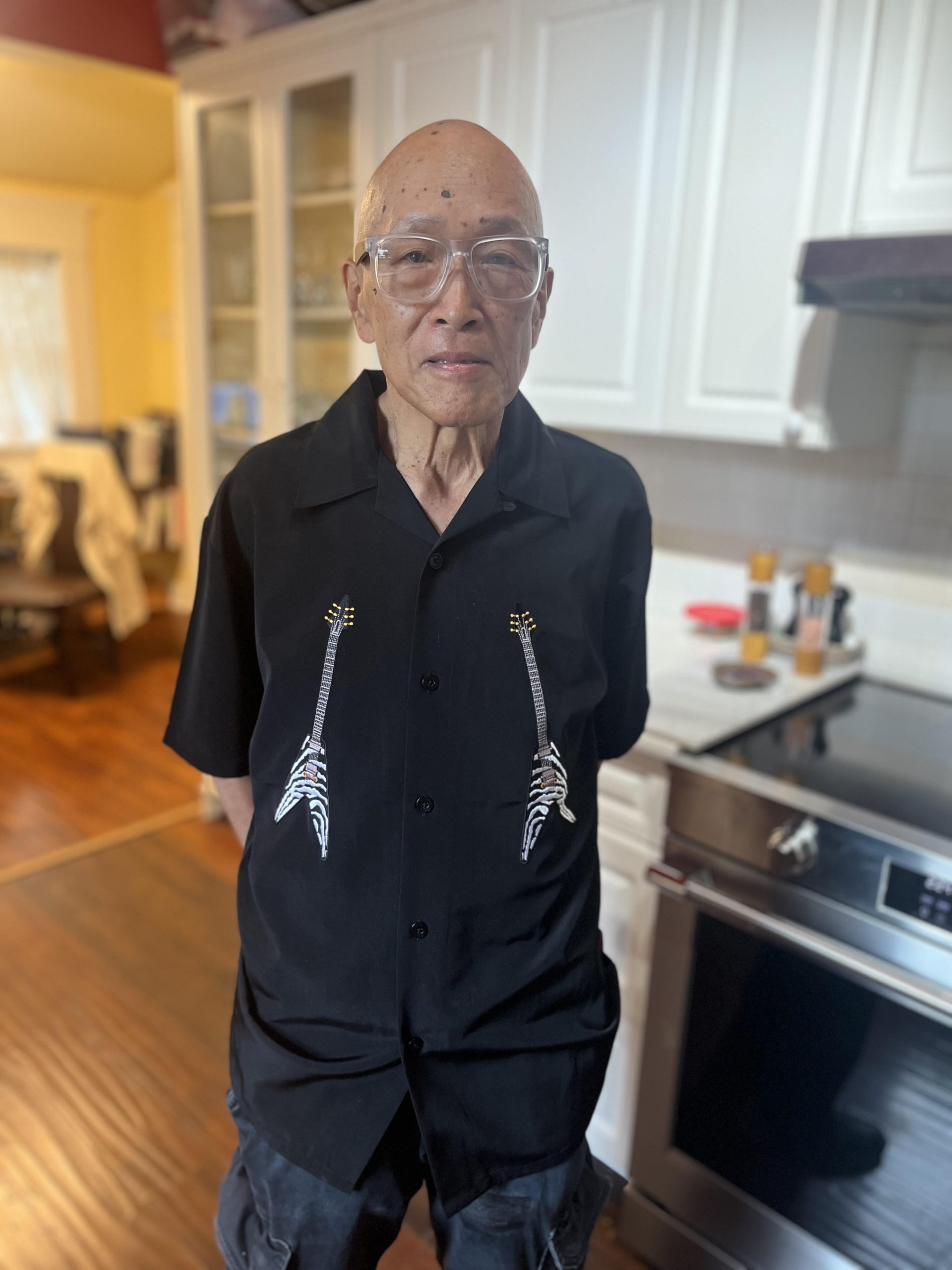
Photo by Effie Pow
Sean: I wish ACWW another 50 years! I’m more into singing these days than playing bass. I’m looking forward to Powell Street Festival’s 50th anniversary and a potential reunion of Kokuho Rose Prohibited. Maybe I should practice my bass. I’ve also been reconnecting with my Hakka roots and introducing my music to younger people.
Effie Pow is a writer/editor and cultural connector interested in storytelling, creative collaboration, and arts-based community engagement. Effie was a storyteller in Gateway Theatre’s True Voices: Pride Storytelling & Tea and Zee Zee Theatre’s Queer Asian Story Collection, and has produced Perilous Words writing workshops (LiterAsian Festival), Hakka Bridges, and Transforming Trauma through Words and Music, inspired by themes of identity, home, and migration. IG @perilouswords
The Artsy Raven podcast interview with Effie and Sean, Ep100 Nurturing Writers for Half a
Century with Effie Pow & Sean Gunn, Asian Canadian Writers’ Workshop (ACWW) was released in
December 2025 [Link]

Many thanks to Mayu Takasaki and Allan Cho for supporting my research for this interview.
References
A Brief History of the ACWW by Jim Wong-Chu (March 2018) [Link]
ACWW History [Link]
Paueru Gaizette (Aug 2023)
History of Gao Hing, Wakayama Group, Powell Street Revue (1967-1972) [Link]
Looking Back: The Powell Street Festival (2015) [Link]
40 years after their final show, Chinatown’s Pender Guy radio is reuniting (2021) [Link]
Sean Gunn’s music
Head Tax Blues [Link]
Hockey Night in Chinatown [Link]
Gim Wong [Link]
Shannon Gunn: On A Mountain (released 2021) [Link]
Shannon Gunn Interview and visuals 1987 Asian Pacific Festival [Link]
Between Pictures: The Lens of Tamio Wakayama (2025) [Link]
In the Shadow of Gold Mountain (2004) [Link]
Our Stories Head Tax Education Project (entry by Jodie Leong) [Link]
The Ties that Bind: Brian Joe (2010) [Link]
On Lee House Documentary History (1984) [Link]
Recognizing Chinese Canadian History in British Columbia (2015) [Link]
Marco Polo History [Link] | [Link] | [Link]
Gim Foon Wong’s motorcycle ride turned the tide on head-tax redress (2013) [Link]
The China-Vancouver Connection: Vancouver Ballet Society [Link]
Densho Digital Repository [Link]
A Grain of Sand: Music for the Struggle by Asians in America (1973) [Link]
Roots: An Asian American Reader (1971) [Link]