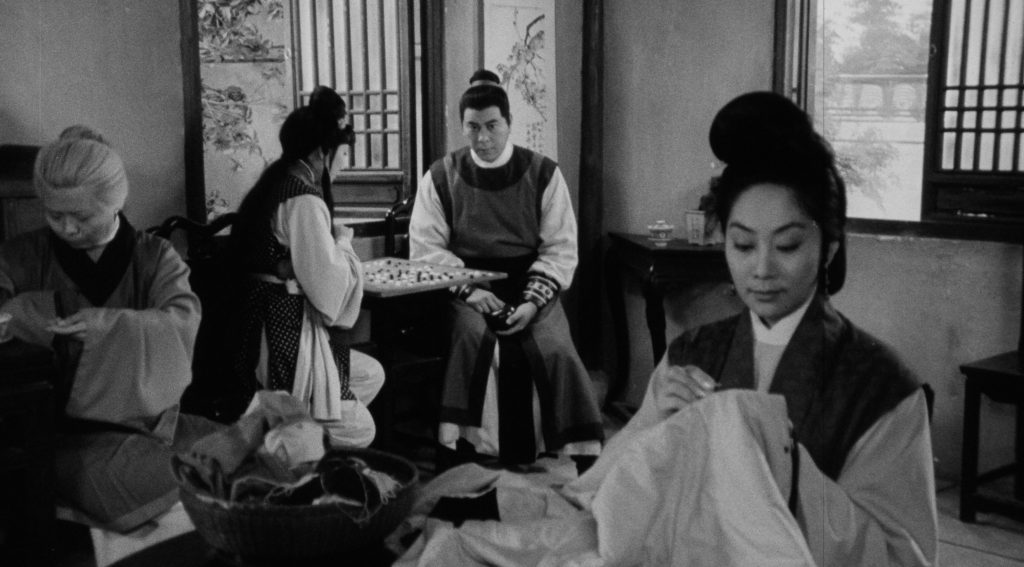
The Arch (Tang Shu Shuen, Hong Kong 1968)
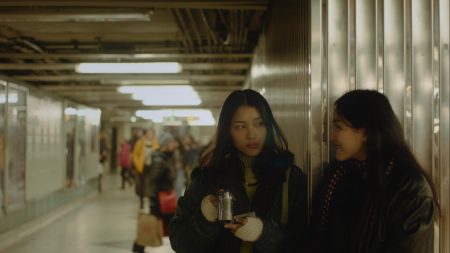 100 Sunset (Kunsang Kyirong, Canada 2025)
Vancouverite Kunsang Kyirong sets her intriguing debut feature in a sterile apartment complex in Toronto’s Parkdale neighbourhood, and through the eyes of a young Tibetan immigrant, captures slices of lives in one of North America’s largest ethnic Tibetan enclaves. In a near-wordless performance, Tenzin Kunsel plays Kunsel, an aloof teenager whose kleptomaniac and voyeuristic impulses lead her to uncover the granular stories and symptoms of the wider community she inhabits. The arrival of the savvy Passang (Sonam Choekyi) and her older husband seeking tenancy under curious circumstances breaks Kunsel out of her stupor when the ladies begin to bond and confide in each other. Central to the plot is the honour system of dhukuti, a grassroots financing scheme popular in South and Southeast Asia where members’ savings are pooled on a regular basis to achieve a fixed rotational payout through bidding. Kunsang has stated that her film is indebted to the work of the late ethnic Tibetan Chinese filmmaker Pema Tseden, whom she credits for representing ordinary Tibetan lives in cinema. Her cast of mostly non-professional actors was sourced from Parkdale’s Tibetan residents. The film’s title refers to the address of the fictional apartment complex the story is set in.
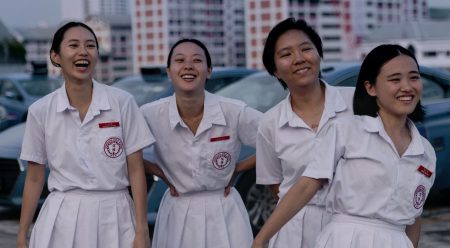 Amoeba (Tan Siyou, Singapore/France/Netherlands/South Korea/Spain 2025)
Dressed in washed out Y2K vibes, Tan Siyou’s nostalgic debut feature is an autobiographical account of her life as a teenager in a rigid all-girls elite school in Singapore around the 2000s. Ranice Tay plays Tan’s persona Xinyu, a precocious 16-year-old dropout who returns to her secondary school for her graduating year and quickly seeks solidarity with three other girls, Vanessa (Nicole Lee), Sofia (Lim Shi-An) and Gina (Genevieve Tan), who like her, are enjoying their rebellious phases. Although described as a “gang”, the quartet is in fact just a very tight clique. Tan’s casting of their fictional Chinese-language school as a social engineering incubator modeled on Confucian education doctrines is plainly a commentary on Singapore’s authoritarian cocoon, but her story also offers a localized peek into language and class politics of the time. Taiwanese actor Jack Kao, a regular in Hou Hsiao-hsien’s films, has a cameo as a charismatic chauffeur of one the girls. Although leads Lee, Lim, Tan and Tay have some stage, screen and filmmaking experience between them, this is their collective debut in a feature film. The film’s title refers to Tan’s childhood anecdote of comparing herself to a solitary and impressionable organism awaiting identity formation.
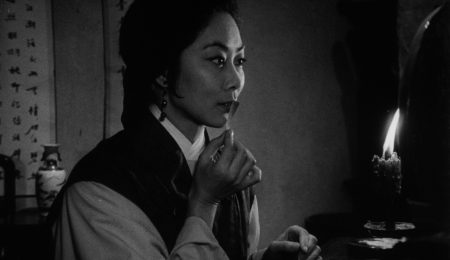 The Arch (Tang Shu Shuen, Hong Kong 1968)
Following its restoration premiere at the 2025 Cannes Film Festival, Tang Shu Shuen’s landmark debut has been on tour. Tang reimagines Lin Yutang’s 1952 short story Arch of Chastity, based on a Ming dynasty tale, making it about a widow and her daughter lusting after a military officer whose unit is garrisoned in their hamlet. Lisa Lu plays the virtuous mother who suppresses her desires while awaiting a court-conferred paifang to exalt her chastity, whereas her daughter (Hilda Chow Hsuan) goes all out to seduce her soldier (Roy Chiao). The history of The Arch’s screening provenance is interesting. Although Cannes claims its 1969 showing was a world premiere (echoed by TIFF), no evidence of the title appears in the Directors’ Fortnight rolls. In truth, Tang personally unveiled her work first at the 1968 San Francisco Film Festival. A 1970 release in Hong Kong followed before it won four prizes at the 1971 Golden Horse Awards: Best Actress (Lu), Best Cinematography (B&W), Best Art Direction (B&W) and a Special Creative Prize. As the film’s original 35mm negatives are lost, this 4K restoration by Hong Kong art museum M+ used two extant prints from 1968. The film’s Chinese title means ‘Lady Dong’.
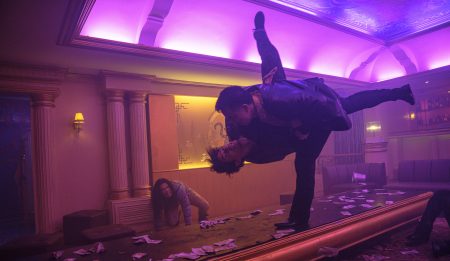 The Furious (Tanigaki Kenji, Hong Kong/China 2025)
For his latest feature, Japanese action choreographer, stuntman, director (and honourary Hongkonger) Tanigaki Kenji summons a Pan-Asian court of action star bluebloods in a as-good-as-it-gets thrill ride about two men on a mission to take down a child trafficking syndicate. After his young daughter is kidnapped off the streets, mute Chinese migrant worker (Xie Miao) teams up with an investigative journalist (Joe Taslim) on the hunt for his colleague girlfriend who was also snatched. The entourage of supporting players is represented by an endless range of martial arts styles led by Jeeja Yanin, Joey Iwanaga, Yayan Ruhian and Brian Le. Although shot on location in Bangkok, the story is set in an unnamed city, yet is furnished with a deliberate mash-up of major Southeast Asian cultural identifiers—principally Thai and Filipino. This recalls the same controversial production design decision in Shen Ao’s No More Bets (2023), which resulted in blowback and bans in various Southeast Asian nations for stigmatizing allusions. Following its TIFF world premiere, the film came in as second runner up in the Midnight Madness section’s People’s Choice Award. The film’s Chinese title reads ‘fire-obscured eyes’, but in Cantonese has the vernacular meaning of being ‘blinded by rage’.
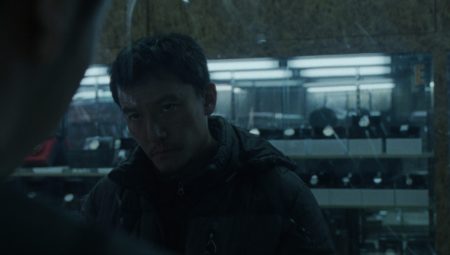 Lucky Lu (Lloyd Lee Choi, USA 2025)
Korean-Canadian Lloyd Lee Choi fuses elements from two of his previous short films, Same Old (2022) and Closing Dynasty (2023) into his affecting debut feature about a migrant worker’s precarious spiral while living in a low-trust jungle. Devoted father and food delivery rider Jiacheng (Chang Chen) has his rental e-bike stolen and is betrayed by a compatriot over an apartment deposit just as he is about to reunite with his wife (Fala Chen) and daughter (Carabelle Manna Wei), who are arriving from China. Although Choi has stated he was inspired by his empathy for the toils of food couriers during the pandemic, his story recalls the plot of Vittorio De Sica’s Bicycle Thieves (1948) even if unintended, while also coinciding nicely with Boris Lojkine’s Souleymane’s Story (2024). Cinematographer Norm Li tightly captures the bowels of New York in a dark range of Prussian blues which evokes both beauty and blemish. At the 2025 Golden Horse Awards, the film won prizes for Best New Director, Best Actor (Chang) and Best Original Score (Charles Humenry). While its Chinese title means ‘The Road to Bliss’, its English title is an alliterative riff on Jiacheng’s family name Lu, which is a homonym for ‘road’.
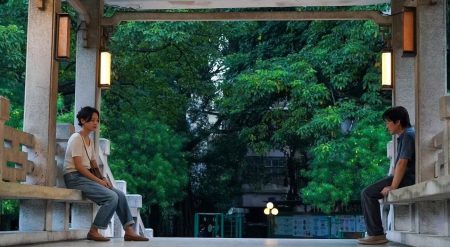 The Sun Rises on Us All (Cai Shangjun, China 2025)
Eight years after presenting The Conformist (2017) at TIFF, Cai Shangjun returns with another involving story about two lovers, but this time flavouring it with melodrama. Set primarily in Guangzhou and its environs, it slowly reveals a chance reunion between a woman (Xin Zhilei) and her former lover (Zhang Songwen) after several years and the burdensome debt he decides to exact from her. Cai and his wife Han Nianjin co-wrote this original story, which was inspired by the traditional Guangdong opera adaption of The Purple Hairpin by Ming Dynasty playwright Tang Xianzu, about two lovers who are reunited by fate after spending years apart. The film’s idiomatic Chinese title is drawn from the first half of a line in the opera and has the literal meaning of ‘the sun at its zenith’, but whose full poetic connotation suggests an impulse between the sexes to seek release and reconciliation despite life’s ups and downs. Korean cinematographer Kim Hyun-seok, an alumnus of Lee Chang-dong’s Poetry (2018) and Wang Xiaoshuai’s So Long, My Son (2019) captures the green humidity of southern China beautifully. At the 2025 Venice Film Festival where the film premiered in the main competition, Xin won the Best Actress prize.
Brandon Wee